July 27, 2026 • Brian Webb • 9 min reading time • Prices verified June 29, 2026
Tube Resistance Bands With Handles: How to Replace a Cable Machine for Under $50 at Home
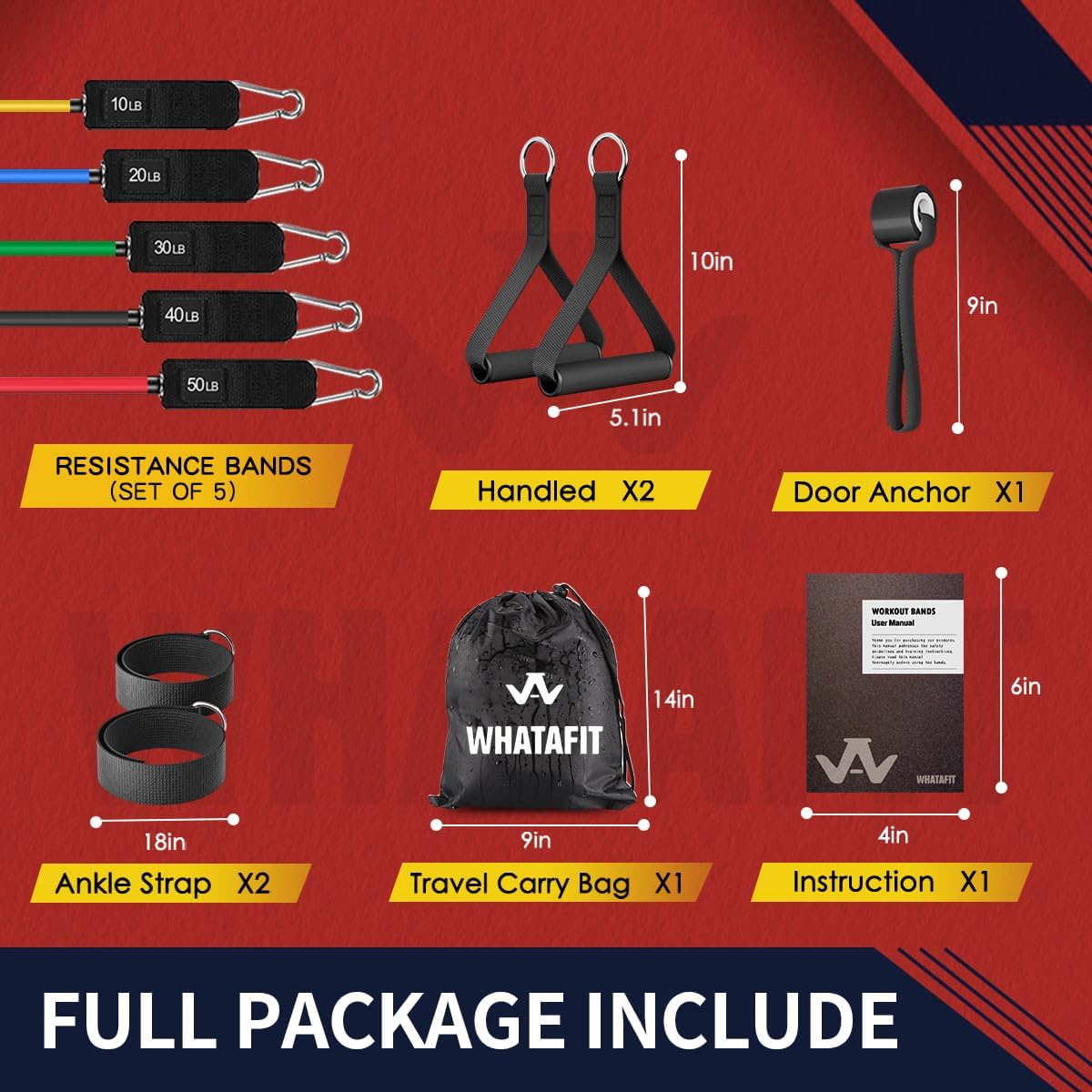
If you’ve ever walked past a cable machine at a commercial gym — that tall, weight-stack contraption with pulleys and a metal handle hanging off it — you’ve seen the piece of equipment that tube resistance bands are quietly replacing in home gyms everywhere. A cable machine lets you pull or push against constant, adjustable tension from almost any angle: high, low, side-to-side. That versatility is hard to replicate at home because free weights (dumbbells, barbells) only pull straight down with gravity. Tube resistance bands with handles solve that problem. A tube band is a hollow rubber or latex cylinder with a clip on each end; you attach foam-grip handles, clip the band to a door anchor or a fixed point, and suddenly you have directional resistance that mimics a cable pulley. A complete set — five bands in different resistance levels, two handles, two ankle straps, and a door anchor — typically costs $20 to $50 at retail. This guide explains how to evaluate those sets, what the tradeoffs are, and exactly when spending a little more is worth it.
What You Actually Get for $20–$50 (and What the Numbers Mean)
Most entry-level tube band sets sold under $50 follow a near-identical formula. You get five tubes in graduated resistance levels, color-coded so you can tell them apart. Manufacturers label each tube with a resistance range — something like “10–35 lb” — and those numbers reflect the tension at a specific stretch length, measured by the manufacturer. It is worth knowing that those figures are not independently verified standards; they are marketing specs, and two brands labeling a band “30 lb” may not feel identical in use. Barbend’s buying guide for resistance bands makes this point directly, noting that resistance ratings across brands are not standardized and shoppers should treat them as relative indicators within a single brand’s lineup rather than cross-brand comparisons.
By the numbers — a typical $30–$45 tube band set:
| What’s included | Resistance range (per tube) | Door anchor included? | Warranty |
|---|---|---|---|
| 5 tubes + 2 handles + 2 ankle straps | ~10 lb to ~50 lb per tube | Yes | 90 days to 1 year |
The important insight here: tubes can be stacked — clip two or three to one handle at the same time — so a five-band set that tops out at 50 lb per tube can theoretically produce 150 lb of combined tension. Whether the handles and clips are built to manage that load safely is a different question, and it’s where quality diverges fast.
The Real Difference Between a $20 Set and a $50 Set
Price in this category is almost entirely determined by three components: latex quality, clip hardware, and handle construction. Owners across aggregated reviews on Men’s Health and Wirecutter’s resistance band coverage consistently identify the same failure points in budget sets: clips that separate from the tube under repeated load, foam handles that compress and lose grip within weeks, and tubes that develop micro-tears near the clip anchors — the highest-stress point during a pull.
Latex quality. Most tubes are made from natural latex or a synthetic TPE (thermoplastic elastomer). Natural latex tends to snap back more crisply and hold resistance more consistently over time; TPE is more hypoallergenic and tends to be used in lower-cost sets. Neither is automatically inferior, but thicker-walled tubes last longer regardless of material. You can check wall thickness in published specs — look for anything listed at 5mm or above on mid-range sets.
Clips and carabiners. The small metal clip connecting the handle to the tube is where most catastrophic failures happen. Budget sets use thin zinc-alloy snap clips. Better sets use steel carabiners with a locking gate — the same style used in light climbing hardware — that won’t open accidentally mid-rep. Wirecutter’s resistance band guide specifically calls out clip quality as the primary durability differentiator in the under-$60 category.
Handle grip. A good handle has a solid plastic or ABS core wrapped in foam. A bad handle is foam all the way through; it compresses, rotates in your hand mid-set, and eventually tears at the attachment point. If a product listing doesn’t mention a core material, assume it’s the cheaper version.
The practical decision rule here: If you’re doing isolated, controlled movements — bicep curls, tricep pushdowns, shoulder rotations — a $20–$30 set will survive. If you plan to stack tubes and load heavy (simulated rows, lat pulldowns, chest presses with serious tension), spend the extra $15–$20 for steel clips and a rigid-core handle. The ACE Fitness resistance training guidelines note that equipment integrity is especially important during pulling movements where sudden band failure can cause the handle to snap back toward the face or torso.
How to Actually Use a Door Anchor (and Not Destroy Your Door)
The door anchor that ships with most tube band sets is a small nylon loop with a padded foam disc on one end. You slot the foam disc over the top, middle, or bottom of a door frame — between the door and the frame — then close the door. The disc sits on the far side; the loop hangs on your side. You clip your band to the loop and the closed door acts as your fixed point.
A few things to get right:
Door direction matters. Always set up so that the force of your pull presses the door into the frame, not away from it. Stand on the same side the door opens toward. If you pull and the door swings open toward you, you’ve set up on the wrong side — reposition.
Frame integrity. Standard interior hollow-core doors and their frames are not engineered for heavy lateral loads. If you plan to stack multiple tubes and generate high tension, owners in long-run reviews consistently recommend using an exterior-grade solid door or a dedicated wall anchor — a bolt-mounted plate available for $15–$25 separately — rather than relying on a door forever. For moderate resistance (two tubes or fewer), door anchors are generally fine.
Height positioning. The anchor position determines the exercise. High anchor (over the top of the door) = lat pulldowns, face pulls, tricep pushdowns. Mid anchor (at handle height) = rows, chest flies, rotational core work. Low anchor (near the floor) = bicep curls, front raises, cable kickbacks. Most sets include a single anchor, but you only need to reposition it between exercises — it takes about five seconds.
Cable Machine Exercises You Can Replicate — and Two You Can’t
Here is a practical list of what transfers well and what doesn’t.
Replaces well:
- Tricep pushdown (high anchor, push down)
- Seated or standing row (mid anchor, pull to torso)
- Chest fly / press (mid anchor, press or fly across body)
- Face pull — a rear-shoulder and rotator cuff exercise (high anchor, pull toward face with elbows high)
- Lat pulldown simulation (high anchor, kneel or sit, pull down toward collarbone)
- Bicep curl (low anchor, curl up)
- Cable kickback for glutes (low anchor, attach ankle strap, kick back)
- Woodchop / anti-rotation core work (high or low anchor, rotate across body)
Doesn’t replicate well:
- Heavy loaded exercises requiring 80+ lb of consistent tension. Bands increase resistance as they stretch, so the load profile is not identical to a weight stack, which delivers constant tension. ACE Fitness research on resistance band mechanics notes this ascending resistance curve as the fundamental difference from free weights or cable stacks — it’s not a flaw, it’s just a different stimulus, but very heavy strength training requires that constant tension.
- Exercises requiring precise cable height micro-adjustments mid-set. A cable machine lets you move the pulley to exact positions; a door anchor gives you three rough positions. For most people, this is not a meaningful limitation.
When to Upgrade Beyond the Door-Anchor Setup
A tube band set with a door anchor is genuinely capable for most beginner-to-intermediate training goals. But there are clear signals that you’ve hit the ceiling:
You’re stacking all five tubes and it still feels easy. You’ve outgrown the kit. Options at that point: a heavy-duty stackable system like the Rogue or Iron Woody resistance band sets ($40–$120), which use thicker flat or loop bands and purpose-built anchor hardware rather than door foam discs; or an actual cable machine — compact cable systems from REP Fitness or Valor Fitness run $300–$600 and provide true constant-tension weight-stack resistance.
Your door anchor is showing wear. If the nylon loop is fraying or the foam disc has compressed flat, replace it before a failure happens. Replacement anchors cost $5–$12 and are sold separately by most band brands.
You’re training clients or multiple people daily. Equipment rated for recreational home use is not built for the repetition cycles of professional training volume. If you’re a trainer or coach using bands in back-to-back sessions, look at commercial-grade options from Perform Better or TRX, whose published specs include higher cycle ratings and longer warranty terms than consumer sets.
The Decision Framework
Here’s how to match your situation to the right purchase:
- If you’re brand new to home training and not sure you’ll stick with it: A $20–$30 set is the right call. Low risk, enough variety to learn the movements, and you lose nothing if the habit doesn’t click.
- If you’re committed to a regular routine and plan to go moderately heavy: Spend $35–$50 and prioritize steel clip hardware and a rigid-core handle. Read the product listing for those specs — they’ll be listed if they’re present.
- If you’re a trainer, coach, or someone training hard six days a week: The $50 tube set is a starting point, not a destination. Budget instead for a wall-mounted anchor plate and a set of heavy-gauge flat bands from a brand like Rogue or Iron Woody — that combination handles real training loads and is built to last years, not months.
- If you want true cable-machine feel with constant tension: Save toward a compact cable system. Tube bands are excellent for the price, but they are a smart approximation, not a perfect substitute.
The honest summary: for under $50, tube resistance bands with handles get you 80% of what a cable machine delivers for 5% of the price. That math holds up for a very wide range of goals — and for everyone else, it’s a clear, low-cost bridge while you save for the real thing.
Sources cited: ACE Fitness Resistance Band Training Guide; Barbend Best Resistance Bands Buying Guide; Men’s Health Best Resistance Bands Review; Wirecutter Best Resistance Bands.