July 18, 2026 • Brian Webb • 9 min reading time • Prices verified June 29, 2026
Soft Kettlebells for Apartment Home Gyms: Floor-Safe, Neighbor-Friendly, and Actually Worth Buying
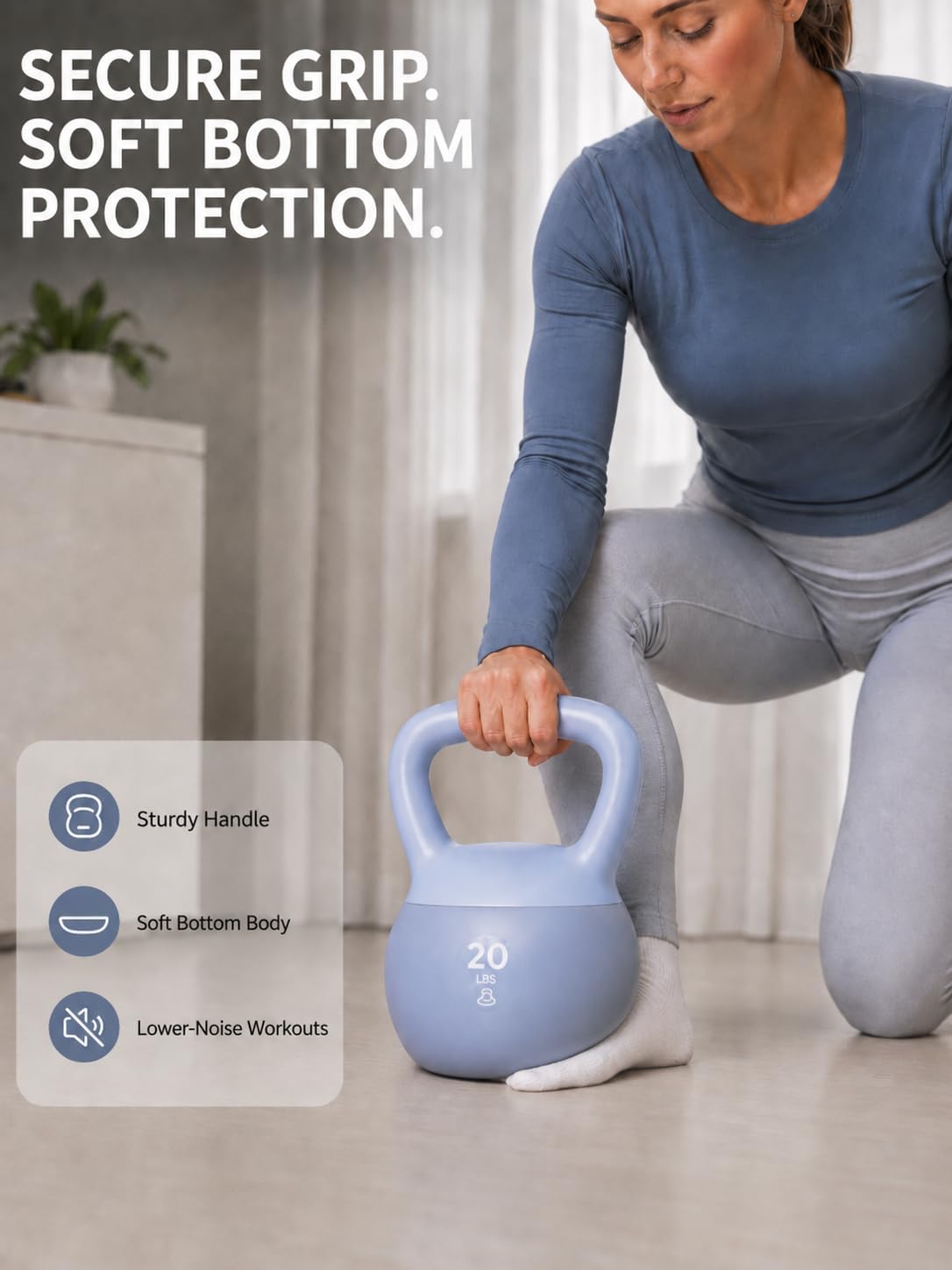
A kettlebell is a cast-iron or steel weight shaped like a cannonball with a handle on top. It’s one of the most versatile pieces of home gym equipment you can own — you can swing it, press it, squat with it, and carry it, all in a few square feet of space. The problem, if you live in an apartment, is obvious: a 35-pound iron ball dropped from knee height hits a hardwood floor with roughly the same diplomacy as a wrecking ball. That’s where soft kettlebells come in. A soft kettlebell replaces the hard shell with a fabric or rubber-encased outer layer — usually filled with sand, steel shot, or a combination — so the weight deforms on contact with the floor instead of bouncing, cracking tile, or rattling the ceiling of your downstairs neighbor at 6 a.m. This guide walks you through what soft kettlebells are, who they’re actually a good fit for, what the tradeoffs look like, and which categories of product are worth your money in mid-2026.
What Makes a Soft Kettlebell Different (And Why It Matters in an Apartment)
The core engineering difference is the shell. A traditional cast-iron kettlebell is a single rigid piece of metal. If you set it down hard during a high-rep swing set — which happens to everyone eventually — it transfers all of that impact energy directly into the floor. In a house with a concrete slab or on a rubberized garage floor, that’s fine. In a third-floor apartment with hardwood over joists, it’s a problem that compounds quickly.
Soft kettlebells address this with one of two constructions:
Sand-filled fabric shells. These are the most common entry-level design. A durable nylon or canvas outer casing is filled with fine sand or steel-shot granules and sewn shut around a structured handle (usually hard plastic or rubber-coated steel). When the bell contacts the floor, the fill shifts and absorbs impact. The floor feels a thud rather than a crack. Owners consistently report that the noise profile drops noticeably compared to dropping iron, which lines up with what reviewers at Barbend describe in their soft kettlebell coverage.
Rubber or vinyl encased bells. A second category uses a hard rubber or thick vinyl coating over a traditional iron or steel core. These don’t deform on impact the way sand-filled designs do, but the rubber layer prevents floor damage and dramatically reduces the metallic “ring” that iron bells produce. They’re closer to a traditional kettlebell in feel — which some experienced lifters prefer — but they’re heavier for their size and don’t compress at all on a miss.
ACE Fitness notes in its kettlebell training overview that the grip and handle geometry of a kettlebell are the most consequential ergonomic factors for technique, particularly in ballistic movements like swings and cleans. This is worth flagging upfront: soft kettlebells vary significantly in handle quality, and a handle that’s too thick, too narrow, or made from slippery material will make technique harder to build — which matters if you’re new to the movement.
The Honest Tradeoffs: What You Give Up, What You Gain
Let’s name this clearly, because some articles in this category soft-pedal the limitations.
What you gain:
- Floor protection. A dropped soft bell won’t gouge hardwood, crack tile, or leave the circular divot that iron leaves on vinyl flooring.
- Noise reduction. The thud is significantly quieter than iron on wood. This is the primary value proposition for apartment training.
- Storage flexibility. Many sand-filled soft bells are slightly compressible and easier to stash under a bed, in a closet, or in a fabric bin without worrying about edge damage to shelves.
- Lower intimidation factor. For genuine beginners, a soft, fabric-covered weight feels less threatening, which is a real psychological on-ramp benefit.
What you give up:
- Precision weighting. Cast-iron bells from manufacturers like Rogue or Wolverson are typically within 1-2% of their stated weight. Sand-filled soft bells vary more — owners across aggregated reviews report occasional discrepancies of 5-10% from stated weight in cheaper versions, which matters if you’re trying to follow a structured progressive overload program.
- Handle consistency. The hard, smooth arc of a traditional kettlebell handle is specifically engineered for the hook grip used in swings and cleans. Fabric-wrapped or soft plastic handles can bunch, flex, or create awkward friction that disrupts technique.
- Longevity under heavy use. Seams on fabric-shell soft kettlebells are a known failure point. Reviewers at Barbend and owner reports aggregated across fitness communities consistently flag that budget fabric bells develop tears or handle loosening within 12-18 months of regular use (3+ sessions per week at higher weights). Higher-quality construction addresses this, but it costs more.
- Ballistic movement suitability. For dynamic movements — kettlebell swings, snatches, cleans — a soft bell’s shifting fill can create an inconsistent center of gravity that makes learning technique harder. Garage Strength’s kettlebell buying guide recommends traditional iron for anyone whose primary goal is ballistic training. For slow-strength work (goblet squats, presses, Turkish get-ups), soft bells perform much more comparably.
By the numbers:
| Factor | Budget Soft Bell (<$40) | Mid-Range Soft Bell ($50–$90) | Traditional Iron (comparable weight) |
|---|---|---|---|
| Weight accuracy | ±5–10% (owner-reported) | ±2–4% (spec-sheet range) | ±1–2% (manufacturer-rated) |
| Handle type | Soft plastic / fabric | Reinforced rubber or hard plastic | Solid iron arc |
| Floor impact | Very low | Low | High without mat |
| Ballistic use suitability | Limited | Moderate | Full |
Who Should Actually Buy a Soft Kettlebell
This is the decision framework most buying guides skip. Not everyone in an apartment needs a soft bell, and not everyone who buys one will be happy with it.
Buy a soft kettlebell if:
- You’re brand new to kettlebell training and want something lower-stakes to learn foundational movements (goblet squats, deadlifts, halos, slow presses).
- Your apartment floor situation is genuinely fragile — older hardwood, thin vinyl, or you’ve already gotten a noise complaint.
- You’re building a travel or temporary kit that needs to pack away easily.
- Your training is primarily strength-focused (slow, controlled movements) rather than ballistic.
Consider traditional iron with a thick mat instead if:
- You plan to do kettlebell swings, snatches, or cleans as the core of your training. ACE Fitness’s kettlebell training overview emphasizes that ballistic movements develop power and cardiovascular conditioning in ways slow movements don’t — and you’ll train them better with proper iron.
- You want to invest in equipment that will last 5-10 years under consistent use. A Rogue or Wolverson bell with a 20mm rubber-backed mat (Vulcan or REP Fitness make solid options) will outlast any fabric-shell soft bell at comparable or not-dramatically-higher cost.
- You’re past the beginner stage and care about weight precision for programming.
The Wirecutter home gym coverage makes a similar point in its general home gym equipment writing: the right mitigation for apartment training is often a quality thick mat plus careful movement control, rather than switching to a fundamentally different implement. A 3/4-inch to 1-inch rubber mat absorbs most of the floor-impact concern with iron bells, keeps noise reasonable, and doesn’t compromise the training tool itself.
What to Look For When Buying (Without Getting Burned)
If you’ve read this far and a soft kettlebell is still the right call for your situation, here’s what actually separates a good purchase from a frustrating one.
Handle rigidity is non-negotiable. The handle must be firm — either hard plastic with a rubberized grip coating or a steel insert wrapped in rubber. Fully soft or fabric handles make swings and cleans nearly impossible to learn safely. Check product descriptions specifically for “reinforced handle” or “steel-core handle” language.
Seam construction matters at higher weights. At lighter weights (10-20 lbs), even budget seam construction holds reasonably well. Above 25-30 lbs, the stress on the seam during a dropped set climbs quickly. Look for double-stitched or welded seams, and check owner reviews specifically for seam durability notes — this is the most common failure mode across aggregated reviews.
Weight range planning. Soft bells in the 15-35 lb range are the sweet spot for what the design does well. Below 15 lbs, the size-to-weight ratio gets awkward (the bell needs to be big enough to hold the fill). Above 35-40 lbs, the shifting fill becomes a more significant liability for technique, and you’re better served by iron.
Brand tier reality check. As of mid-2026, there’s no Rogue or Eleiko equivalent in the soft kettlebell category — the segment skews toward mass-market brands. That means you’re comparing largely on construction details and owner consensus rather than brand pedigree. Budget around $40-$60 for a single bell in the 20-30 lb range from a reputable fitness brand (look for established sporting goods names, not anonymous marketplace listings) and expect to replace it in 2-3 years of regular use.
The Bottom Line: Clear “If/Then” Rules
If you’re a complete beginner who lives in an apartment and wants to start learning kettlebell movements without worrying about your floors or neighbors: a mid-range soft kettlebell (reinforced handle, double-stitched seams, 20-30 lb range) is a reasonable starting point. Go in knowing it’s a learning tool, not a forever piece of equipment.
If you’ve been training for more than a few months and want to do ballistic work (swings, cleans, snatches): buy a traditional iron bell and invest the price difference into a quality rubber mat. The mat solves the floor and noise problem without compromising the implement.
If your primary concern is purely noise for a neighbor below you: a rubber-encased iron bell on a 3/4-inch rubber mat may actually outperform a fabric soft bell, because the rubber coating prevents ringing and the mat absorbs drop impact — while keeping the handle geometry you need for good technique.
If you want one bell that does everything adequately and takes the apartment anxiety off the table completely: the rubber-coated iron bell on a thick mat is the more durable answer. But if budget is tight right now and you’re truly just starting out, a quality soft bell at $50-$60 is a reasonable bridge — just treat it as a bridge, not a destination.
Apartment training is completely doable with kettlebells. The equipment choice matters less than actually showing up consistently. Pick the option that removes friction for your specific situation, and start training.