August 11, 2026 • Brian Webb • 10 min reading time • Prices verified June 29, 2026
Resistance Bands for Travel Workouts: The Compact Sets That Actually Deliver
You’ve been squeezing workouts into hotel rooms and Airbnbs for years, or maybe you’re brand new to fitness and just trying not to lose momentum the next time work takes you away from home. Either way, you’ve probably wondered whether a small bag of rubber bands can actually replace a gym. The short answer is: yes, with the right set. Resistance bands are elastic loops or tubes — made from latex or similar synthetic rubber — that create tension when you stretch them, giving your muscles something to push or pull against, the same basic principle as lifting a dumbbell. They weigh almost nothing, fold into a corner of your bag, and can train your whole body from chest to glutes. This guide will walk you through the four band types most traveled-with today, show you the honest tradeoffs between them, and give you a clear decision framework so you leave knowing exactly which set fits your situation.
The Four Band Types Worth Knowing Before You Buy
Not all resistance bands are the same, and the difference matters when you’re living out of a carry-on. There are two main formats you’ll see in travel-focused sets.
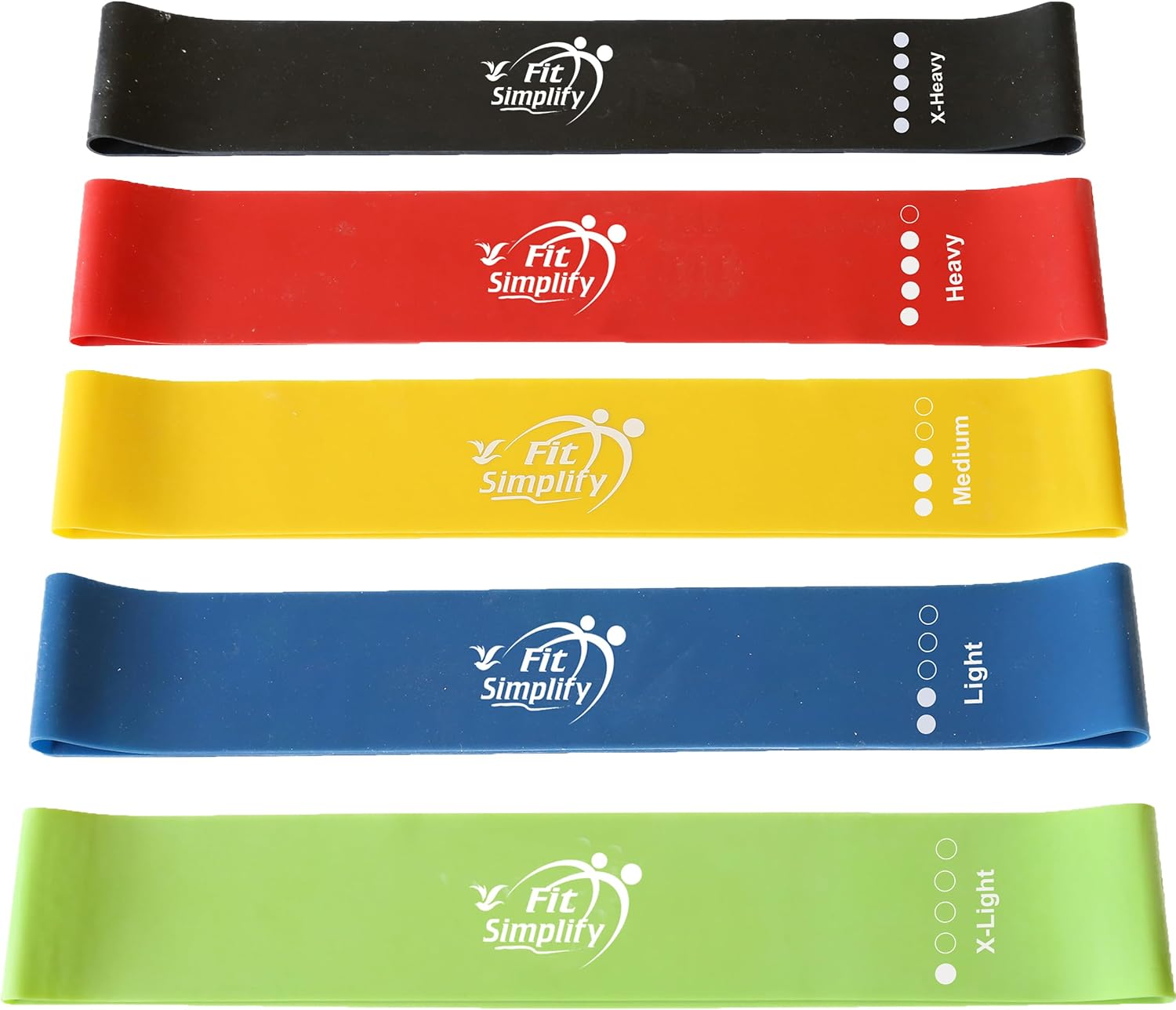
Loop bands (also called mini bands or flat loop bands) are flat, closed rings of latex — think a thick rubber band the size of a bread loaf. They’re typically sold in sets of five, each color-coded to a different resistance level, from light to extra-heavy. The Fit Simplify loop band set is the most widely reviewed entry in this format, and owners consistently praise how it disappears into a bag without adding noticeable weight. Reviewers who have compared loop bands and tube bands note that loop bands produce no detectable rubber odor — a practical point worth flagging before we discuss the tube side of things.
Tube bands with handles are cylindrical rubber tubes with plastic or foam-grip handles on each end, sometimes sold with a door anchor (a small strap you thread through a door frame to anchor the band) and ankle attachments. Sets like WHATAFIT, VEICK, and WIKDAY all follow this format. You typically get five individual tubes of varying resistance, and the system works by clipping tubes together to stack resistance levels — more tubes attached at once means more total tension. This stacking feature is the key reason tube sets appeal to people who want to approximate strength-training loads while on the road.
By the numbers:
- Average loop band set weight: under 1 lb (fits in a jacket pocket)
- Average tube-band-with-handle set weight: 1.5–2.5 lbs with door anchor and bag
- Tube bands claimed stackable resistance range: typically 10–150 lbs combined
- Flat loop bands typical resistance range: 5–50 lbs depending on set
The Honest Durability Picture: What Owners Actually Report
Before spending money, it helps to know what tends to go wrong — because something always does eventually with elastic gear.
WIKDAY tube band owners provide some of the most detailed long-run durability data in aggregated reviews. The pattern across reviews shows the sets holding up well for close to three years under regular use before band failure becomes likely. That’s a strong result for a travel set. One safety detail worth surfacing: at least one owner reported a band snapping mid-pull-up — a meaningful reminder that tube bands under load can fail suddenly, not gradually. Barbend’s resistance band guide consistently recommends inspecting bands for nicks, surface cracks, or whitening of the latex before each session, especially on exercises where a snap would send your hands or face toward a hard surface.
WHATAFIT tube sets earn strong marks for value in aggregated reviews, but one recurring practical complaint — surfaced in a notable four-star review — is a chemical smell that lingers on hands after use. This isn’t unique to WHATAFIT; it’s a latex-curing byproduct common to tube bands of this price tier. Outside Online’s travel fitness coverage notes that airing bands out of their carry bag for 30–60 minutes before use significantly reduces the odor. Storing them in a vented mesh bag rather than a sealed stuff sack between trips also helps.
VEICK tube sets draw broadly similar feedback: durable clips, good included accessories, comparable smell profile to other tube sets. Owners consistently note the clip connectors as the most likely failure point over time — not the bands themselves — so carrying a spare carabiner-style clip (often included as an extra in the set) is smart practice.
Fit Simplify’s 12-piece tube set stands out in reviews for one feature most competitors skip: an illustrated instruction booklet. Reviewers say this is genuinely useful — multiple owners report it allowed them to run a complete workout in an unfamiliar hotel room without needing their phone or a trainer. The included over-door anchor attachment also earns specific praise for its foam padding, which owners report distributes force more evenly across a door frame edge than bare-strap anchors.
How to Think About Which Set to Buy
This is where the decision framework actually matters. Use this:
If you want the smallest possible footprint and you mainly do lower-body, mobility, and bodyweight-complement work — loop bands are your answer. The Fit Simplify loop set disappears into a zippered pouch, produces no odor, and handles squats, glute bridges, lateral walks, and banded push-ups cleanly. ACE Fitness’s resistance training guide notes that mini loop bands are particularly effective at activating hip abductors and stabilizer muscles that bodyweight-only training tends to underwork — meaningful for anyone running or walking a lot during travel days.
If you want a full-body strength substitute and you’re willing to carry a little more — a quality tube set like WIKDAY or WHATAFIT is the better call. The stacking system gives you enough resistance range to load rows, chest presses, bicep curls, and shoulder work at levels that begin to approximate dumbbell training. Wirecutter’s resistance band coverage notes that stacked tube bands still don’t perfectly replicate free-weight training (the tension curve feels different at lockout vs. at midpoint), but for a travel-week bridge between gym sessions, the stimulus is real.
If you’re a trainer or coach packing for a client-facing trip — the Fit Simplify 12-piece tube set’s included booklet and door anchor make it the most self-contained client-handoff tool in this price tier. You can hand the full kit to a client in a hotel room and have them run the program independently.
If odor in shared luggage is a concern — loop bands are the clear choice. Tube bands can off-gas even inside a sealed bag, and if you’re sharing luggage space or packing in a backpack alongside clothing, that matters.
Frequently Asked Questions
How do I use a door anchor safely in a hotel room?
A door anchor is a small strap with a foam or rubber stopper on one end. You thread the strap through the gap between the door and the frame at the height you need (low for rows, high for pull-down movements), then close the door — the stopper catches against the door’s edge and holds the band in place. The key safety step: always use the door anchor on the hinge side of the door, not the latch side. The hinge side is reinforced and opens away from you under load; the latch side can pop open under tension. Test the door first with light tension before loading up. Some hotel doors — hollow-core interior doors in older properties — don’t hold anchor forces well at high resistance. If the door flexes noticeably under moderate tension, use a low-anchor point (close to the floor hinge) where the structure is strongest, or switch to floor-anchored exercises instead.
Which band type gives the most exercise variety in the smallest package?
Tube bands with handles give more exercise variety, primarily because the handles allow horizontal pressing and pulling movements (simulating chest press, rows, shoulder press) that flat loop bands can’t cleanly replicate. A five-tube stackable set with door anchor, ankle straps, and handles covers pushing, pulling, hinging, squatting, and isolation work from one bag. Loop bands are more limited to lower-body, banded bodyweight, and mobility work — excellent for that purpose, but narrower in range.
Will resistance bands smell up my luggage?
Tube bands can, yes — particularly when new. The smell comes from residual compounds used in the latex vulcanization process (the heat treatment that cures the rubber). Owners of WHATAFIT and similar tube sets commonly report it. The smell fades significantly over the first few weeks of use and with regular airing. Loop bands in the Fit Simplify format are consistently reported as odor-neutral or close to it. If smell is a real concern, air tube bands outside their pouch for an hour before repacking, and store in a mesh rather than sealed bag.
How long should a travel resistance band set realistically last with regular use?
Based on aggregated owner reviews — particularly the detailed WIKDAY durability reports — a quality tube set used two to four times per week during travel (not every single day) can realistically last two to three years before a band snaps. Loop bands in lighter resistance levels tend to fail first, particularly if used for high-rep lower-body work where the band is fully stretched repeatedly. Consumer Reports’ home fitness equipment guidance recommends replacing any band showing surface discoloration, latex whitening, or small surface tears immediately — failure under load can be abrupt.
Can I stack tube bands to get enough resistance for strength training on the road?
You can get meaningful load — WHATAFIT and WIKDAY sets are typically marketed with a combined stacked resistance of up to 150 lbs across all five bands. In practice, owners report that the feel differs from free weights because resistance increases as you stretch the band further (known as the accommodating resistance curve), meaning the hardest part of a movement is at full extension rather than at the sticking point. This isn’t a flaw — it’s just different, and worth knowing so you adjust your expectations. For maintaining strength during a one- or two-week trip, the stimulus is absolutely real. For building peak strength as a primary training mode, free weights remain superior.
What is the roll of tape included with some band sets for?
Some tube band sets — particularly value-tier sets — include a roll of self-adhesive grip tape or handle-wrap tape. Its purpose is to reinforce the junction between the rubber tube and the plastic clip connector, which is the most common point of wear in the set. If your clip connector starts to feel loose or the tube shows slight fraying where it meets the metal ring, wrapping that junction with several layers of grip tape extends the set’s life meaningfully. A few owners also use it to build up handle grip diameter for comfort on longer sessions.
The Bottom Line
Resistance bands are one of the few pieces of fitness gear where a $20–$40 investment genuinely solves a real problem — the week you miss three workouts because you’re three time zones from your gym. The tradeoff between loop bands and tube sets comes down to one question: do you mainly want lower-body and mobility support with zero hassle, or do you want a full-body strength substitute with a small amount of extra setup? Loop bands win on simplicity, odor, and size. Tube sets win on exercise range and stackable resistance. Both deliver on the core promise. Pick the format that matches your travel reality, inspect your bands before every session, and replace them at the first sign of surface cracking. The gear is inexpensive enough that swapping out a worn set is always the right call.