September 8, 2026 • Brian Webb • 12 min reading time • Prices verified June 29, 2026
Premium Adjustable Dumbbells for Heavy Home Gym Training: PowerBlock 90 vs. NuoBell 80 vs. The Pin-Lock Challengers
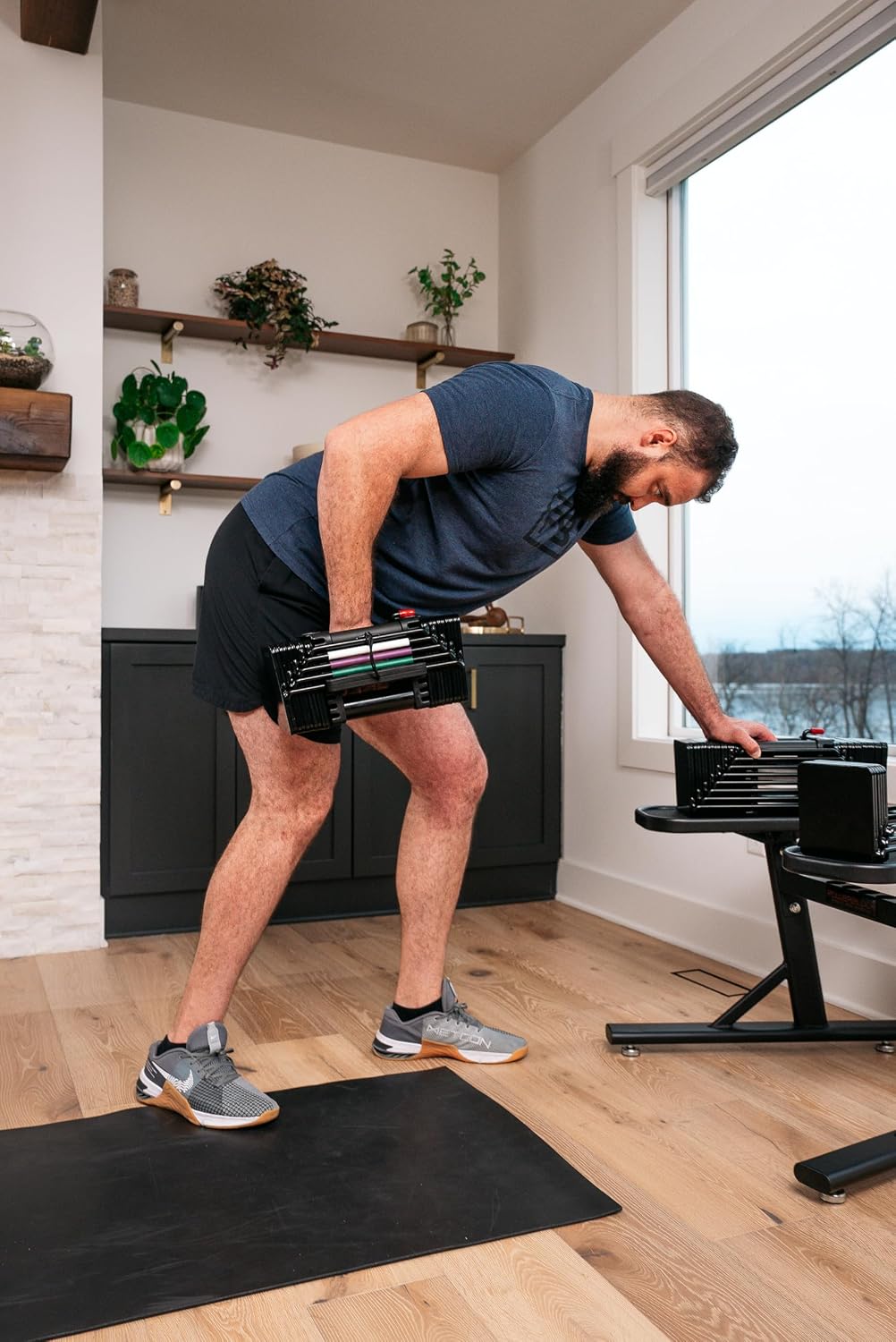
If you’ve been lifting weights for a while — or you’re just getting serious about building a permanent home gym — you’ve probably noticed that dumbbells take up enormous floor space. A traditional fixed-weight dumbbell rack covering 5 lb all the way to 90 lb can cost $1,500 and swallow half a spare room. An adjustable dumbbell solves that problem by packing an entire rack’s worth of resistance into a single handle: you twist a dial, slide a pin, or click a selector, and within seconds you’ve changed from a 15 lb warm-up to a 70 lb working set. The trade-off is mechanical complexity, and at the premium end of this market — sets that top out at 80 to 90 lb per hand — that complexity costs real money. This guide compares the two strongest names in the premium selector-style category (PowerBlock Elite 90 and NuoBell 80) against the pin-lock challengers that serious lifters keep nominating as under-the-radar alternatives, so you can decide which pair belongs in your space.
| EDITOR'S PICKPowerBlock Elite USA 90 Pound A… | Mid-tierEisenlink Adjustable Dumbbell S… | Budget pickPowerBlock Elite EXP Adjustable… | |
|---|---|---|---|
| Weight range | 5–90 lb | 10–80 lb | 5–50 lb |
| Increment | — | 5 lb | — |
| Lock type | — | Quick-lock | — |
| Includes stages | 1, 2 & 3 | — | Stage 1 |
| Expandable | ✓ | — | ✓ |
| Price | $869.00 | $529.00 | $399.99 |
| See on Amazon → | See on Amazon → | See on Amazon → |
What “Premium Adjustable” Actually Means — and Why It Matters at Heavy Weights
The $50–$150 adjustable dumbbell you’ll find at a big-box sporting goods store works fine at light loads. Problems surface when you push north of 50 lb per hand: cheap dial mechanisms bind under real tension, plastic selector trays crack, and balance shifts off-center because the weight distribution was not engineered for heavy lifting. At that weight, a wobbling or slipping dumbbell is not just annoying — it is a safety issue during heavy rows, incline presses, or Romanian deadlifts.
Premium adjustable dumbbells are engineered differently. Higher-grade steel internals, tighter manufacturing tolerances, and purpose-designed weight plates produce a unit that feels closer to a fixed commercial dumbbell — dense, balanced, and confidence-inspiring when you are grinding out a set of heavy chest-supported rows at close to your limit.
Two failure modes send lifters from mid-market to premium, and both are worth naming. Wirecutter’s 2025 review of adjustable dumbbells, titled “The Best Adjustable Dumbbells,” documents selector-dial jamming as a recurring complaint on mid-market products after 12 to 18 months of regular use. Barbend’s 2025 “Best Adjustable Dumbbells” buyer’s guide separately reports cracked weight plates as the second most common owner-reported failure, often triggered by drops. If either of those sounds familiar — former Bowflex 552 owners consistently cite broken discs and stuck dials as the exact reasons they upgraded — this comparison is written for you.
The Main Contenders: How They Work and What Owners Say
PowerBlock Elite 90
PowerBlock
$869.00
In stock on Amazon
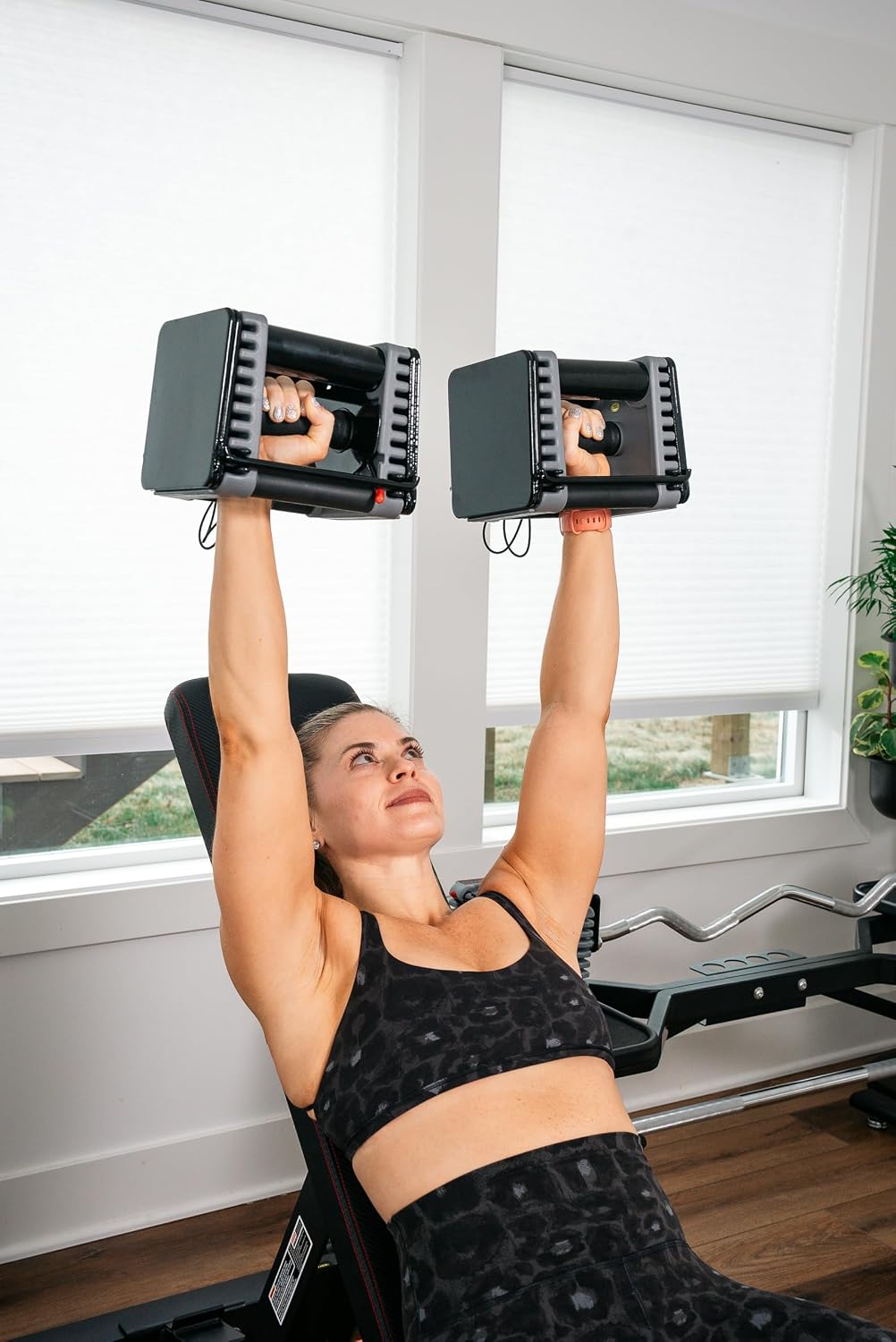
Check price on AmazonThe PowerBlock Elite 90 adjusts from 10 lb to 90 lb per hand in 2.5 lb increments below 50 lb and 5 lb increments above it. The design is immediately distinctive: a steel cage surrounds the handle, with weight sleeves that slide into the cage framework rather than hanging off a traditional bar. You pull a pin, reposition it, and the unused weight stays on the stand.
The cage geometry is the point of the most active owner debate. Barbend’s 2025 “Best Adjustable Dumbbells” buyer’s guide consistently notes that the cage works seamlessly for standard pressing, rowing, and curling patterns, but can feel restrictive during exercises that require a neutral-to-pronated wrist rotation through a full arc — think spider curls or certain hammer-grip variations. Grip width is fixed by the cage, which is worth knowing before you buy.
What is less debatable is the durability record. One review pattern that carries significant weight in owner communities is the multi-decade user: PowerBlock owners who purchased their first set in the early 2000s and are now adding a 90 lb set — not replacing a broken one, but expanding capacity. That is a 20-plus-year product lifespan documented across multiple review sources, and if you run the math, it changes the economics completely.
Lifetime value math: A PowerBlock Elite 90 set at roughly $600 spread over 20 years of use works out to $30 per year, or under $3 per month. A $200 mid-market set that fails at 18 months costs more per year of service, not less.
Men’s Health’s 2025 “Best Adjustable Dumbbells for Home Gyms” roundup flags PowerBlock’s selector pin mechanism as notably reliable compared to twist-dial competitors, specifically calling it less prone to the plastic-on-plastic wear that causes dial stiffness over time.
Best for: Lifters who want the longest documented track record, train primarily in standard movement patterns, and plan to own a single set of adjustable dumbbells for 15 or more years.
PowerBlock
$869.00
In stock on Amazon
Check price on AmazonNuoBell 80
Eisenlink
$529.00
In stock on Amazon
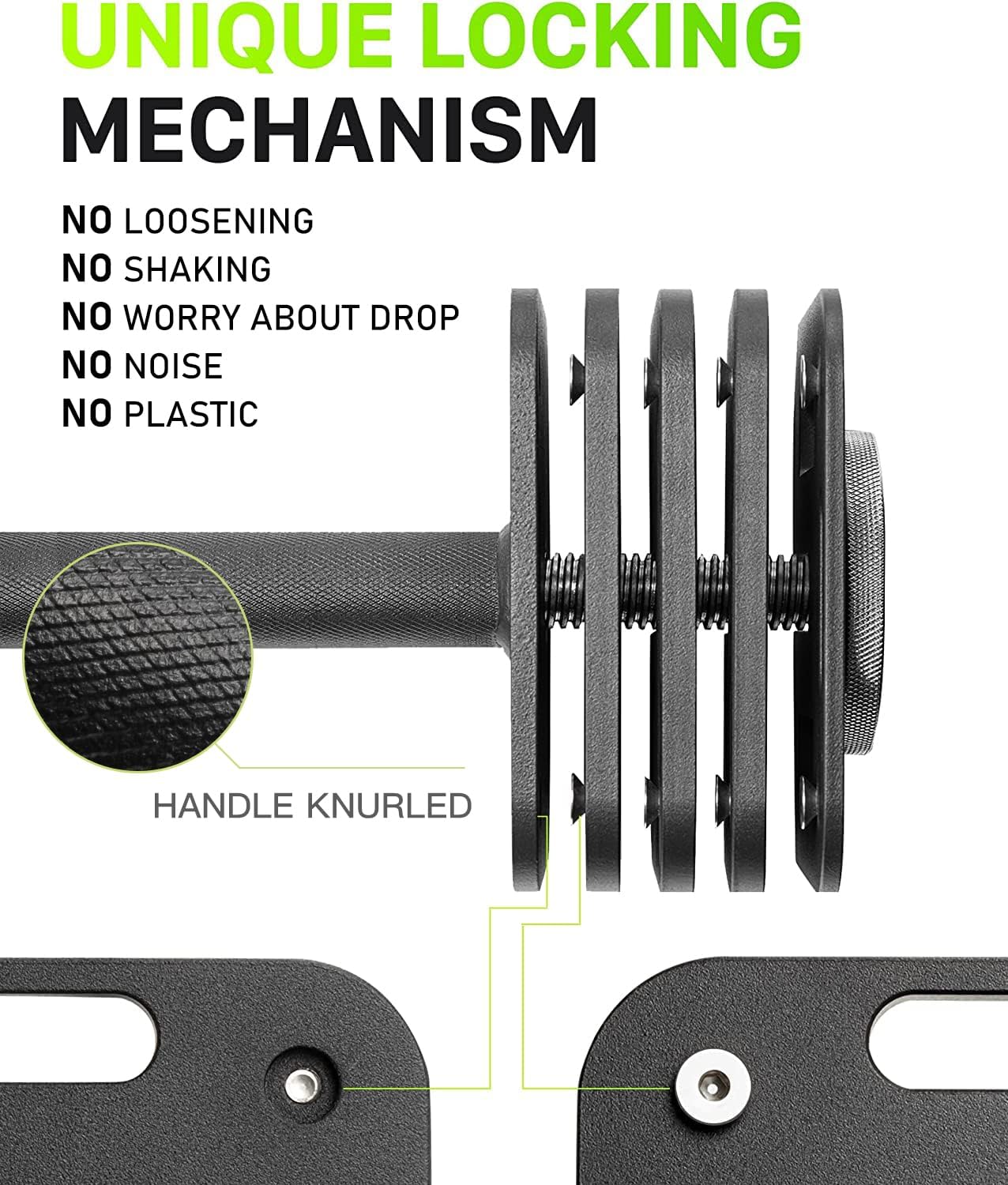
Check price on AmazonThe NuoBell takes the twist-dial approach — similar to Bowflex SelectTech in concept — but executes it with significantly tighter tolerances and a more commercial-grade feel. The range runs 5 lb to 80 lb per hand. The dial rotates smoothly and indexes cleanly into each weight position.
The benchmark owners reach for is instructive: NuoBell reviewers aggregated in Barbend’s 2025 “Best Adjustable Dumbbells” buyer’s guide describe balance and feel as equivalent to a commercial gym dumbbell. That is not a casual comparison. If you have trained in a well-equipped commercial facility and know what a fixed-weight dumbbell feels like during a heavy neutral-grip press — dense, balanced along its entire length, no flex or wobble — that is the sensory target NuoBell is hitting for most users.
The shape also matters for exercise variety. Because the NuoBell is roughly cylindrical rather than caged, it accommodates a wider range of grip positions and wrist-rotation patterns than the PowerBlock design. Owners who prioritize exercise variety — particularly those who program a lot of dumbbell pressing variation — tend to prefer it for that reason.
Stability in heavy compound movements is a real question for any adjustable dumbbell. Across aggregated NuoBell owner reviews covered in Barbend’s guide, wobble during heavy rows and presses is rarely cited as an issue, which separates it meaningfully from mid-market twist-dial designs. The mechanism locks under load rather than flexing.
Best for: Lifters who train a wide variety of exercises, want a feel that matches a commercial gym dumbbell, and prefer a cylindrical shape that does not constrain grip rotation.
Eisenlink
$529.00
In stock on Amazon
Check price on AmazonThe Pin-Lock Challengers: CAP AdjustaBell and Similar Designs
PowerBlock
$399.99
In stock on Amazon
Check price on AmazonPin-lock adjustable dumbbells — designs where physical steel pins secure the weight plates rather than a dial or selector — have a dedicated following among powerlifting-style and strength-focused home gym builders. The mechanism is simpler: fewer plastic components, no selector tray to crack, and a traditional bar feel that some lifters strongly prefer.
The trade-off is adjustment speed, and this is where programming context matters enormously. When you are doing strength-focused training with 4-minute rest periods between heavy compound sets, a 5-second weight change versus a 2-second dial twist is completely irrelevant. Slow adjustment speed only matters if your programming demands rapid weight cycling — circuit training, supersets, or EMOM (every-minute-on-the-minute) formats where you are moving between exercises with minimal rest.
ACE Fitness’s educational resource “Strength Training: How Much Weight Should You Lift?” reinforces this point from a training-load perspective: the demands of your chosen program should dictate equipment selection, not the other way around. For low-rep, high-load, long-rest programming — classic strength-building periodization — a pin-lock design is a legitimate challenger that costs less and has fewer mechanical parts to fail over time.
Men’s Health’s 2025 “Best Adjustable Dumbbells for Home Gyms” roundup acknowledges pin-lock designs as durable and reliable for exactly this type of use case, even if they do not make the top selector-style picks.
Best for: Lifters on a tighter budget whose training is strength-focused with long rest periods, and who would rather have a simpler mechanism with fewer plastic failure points than faster adjustment speed.
PowerBlock
$399.99
In stock on Amazon
Check price on AmazonSide-by-Side: Key Specifications
| Feature | PowerBlock Elite 90 | NuoBell 80 | CAP AdjustaBell (pin-lock) |
|---|---|---|---|
| Max weight per hand | 90 lb | 80 lb | Varies by config (up to 90 lb) |
| Adjustment mechanism | Selector pin | Twist dial | Manual pin |
| Adjustment speed | ~3 seconds | ~2 seconds | ~5–10 seconds |
| Shape | Cage / rectangular | Cylindrical | Traditional bar |
| Durability (owner consensus) | Excellent / 20+ yr examples | Very good | Good; fewer failure points |
| Price range | ~$550–$650 | ~$450–$550 | ~$200–$350 |
How Programming Should Drive Your Decision
ACE Fitness’s “Strength Training: How Much Weight Should You Lift?” makes a point experienced lifters already know from practice: the type of training you do dictates which equipment constraints matter. The wrong tool for your programming style does not just create inconvenience — it actively works against how the session is structured.
For high-volume, fast-moving formats (supersets, circuits, metabolic conditioning), adjustment speed is a real variable in workout flow. The NuoBell’s dial and the PowerBlock’s selector pin both move quickly enough to keep rest periods honest. Pin-lock designs will slow you down in these contexts, and that friction compounds across a full session.
For low-rep, heavy, long-rest formats (strength-focused programs, powerlifting-adjacent work), adjustment speed is nearly irrelevant. The pin-lock’s simplicity and lower price become genuine advantages precisely because the 5-second penalty never shows up in your training.
For wide exercise variety — lots of pressing variation, unilateral work, carries — the NuoBell’s cylindrical shape gives you more grip flexibility. The PowerBlock cage handles standard patterns well but constrains some specialty movements, as documented in Barbend’s 2025 buyer’s guide.
For long-term ownership (10-plus years), the PowerBlock’s documented multi-decade reliability record is a concrete argument. The NuoBell’s owner base is younger — the product launched in 2021 — so long-run failure data is still accumulating, though early-owner reports covered by Barbend are strongly positive.
One pattern worth flagging for serious home gym builders: at this investment level, adjustable dumbbells and adjustable kettlebells increasingly function as complementary tools rather than competing ones. Heavy-hinge and ballistic movements (swings, cleans, snatches) belong to the kettlebell; pressing, rowing, and isolation work belongs to the dumbbell. The lifter who uses both in the same session is training with the right tool for each movement pattern, not overcomplicating their setup.
What Happens If You Drop Them?
This question does not get asked enough. Premium adjustable dumbbells are not designed to be dropped from full overhead height — none of them are, and no manufacturer warranties against drop damage. That said, owners across both PowerBlock and NuoBell communities consistently report that incidental drops — the kind that happen at the end of a hard set when the weight is already close to the floor — are generally tolerated without mechanism failure.
The critical failure mode is dropping the dumbbell onto its end or directly onto the selector mechanism from significant height. Fixed-weight dumbbells are effectively immune to this; adjustable designs never will be. If you train on exercises where releasing the weight at the end of a set is common — heavy dumbbell chest press to failure being the obvious example — build the habit of rolling the weight off onto a crash pad or knee rather than releasing it.
Frequently Asked Questions
Is the PowerBlock cage comfortable to grip for all exercise types? For the majority of standard exercises — rows, presses, curls, lateral raises, lunges — owners report no issues. The cage becomes a constraint on movements requiring full wrist rotation through an arc, like certain curl variations. If those movements are central to your programming, the NuoBell’s cylindrical design is the better fit.
Does the NuoBell stay stable during heavy rows and presses, or does it wobble? Across owner reviews aggregated in Barbend’s 2025 “Best Adjustable Dumbbells” buyer’s guide, wobble is not a commonly reported issue during heavy compound movements. The mechanism locks under load — one of the areas where NuoBell clearly differentiates itself from mid-market twist-dial designs.
What is the maximum weight available in adjustable dumbbell format, and who actually needs it? Selector-style adjustable dumbbells currently top out at 90 lb per hand in the PowerBlock configuration. Pin-lock and loadable designs can go higher. In practical terms, 80 to 90 lb per hand covers single-arm pressing and rowing for nearly all recreational lifters, including strong ones. If you are pressing a 90 lb dumbbell for reps, you are training at an advanced level where fixed-weight dumbbells or a barbell are likely already in your space.
How does adjustment speed affect real workout programming? It depends entirely on your rest periods and whether you are changing weights mid-session. For EMOM and circuit formats, fast adjustment matters. For strength programming with 3-to-5-minute rests, it does not. The pin-lock’s slower mechanism is a genuine non-issue for powerlifting-style training, as ACE Fitness’s training load guidance implicitly supports — the right load for the goal matters far more than how quickly you reach it.
Are premium adjustable dumbbells worth the price over a fixed dumbbell set at the same weight range? A fixed dumbbell set from 5 to 90 lb runs $1,200 to $2,000 or more and requires a dedicated rack taking 8 to 10 feet of floor space. Premium adjustables cover the same range in two units stored on a compact stand. For most home gym builds, the space math alone justifies the premium — before accounting for the durability advantage over time.
The Decision Framework
-
If you want the longest documented track record and train primarily in standard movement patterns, the PowerBlock Elite 90 is the defensible choice. The 20-year ownership data is real, and the cost-per-year math is hard to argue with. PowerBlock — $869.00
-
If you train a wide variety of exercises and want a feel that matches a commercial gym dumbbell, the NuoBell 80 is the closer match — cylindrical shape, commercial-grade feel, and strong early-owner consensus on stability. Eisenlink — $529.00
-
If your training is strength-focused with long rest periods and you would rather have a simpler mechanism at a lower price, a quality pin-lock design competes seriously. Adjustment speed simply does not matter for that programming style. PowerBlock — $399.99
-
If you are on the fence between mid-market and premium, run the failure-mode check first: have you already experienced dial jamming or cracked plates on a previous set? If yes, the upgrade to premium pays for itself in the first replacement cycle you do not have to make.