July 28, 2026 • Brian Webb • 10 min reading time • Prices verified June 29, 2026
PowerBlock vs. NuoBell vs. Bowflex: The Premium Adjustable Dumbbell Showdown for Serious Home Gym Builders
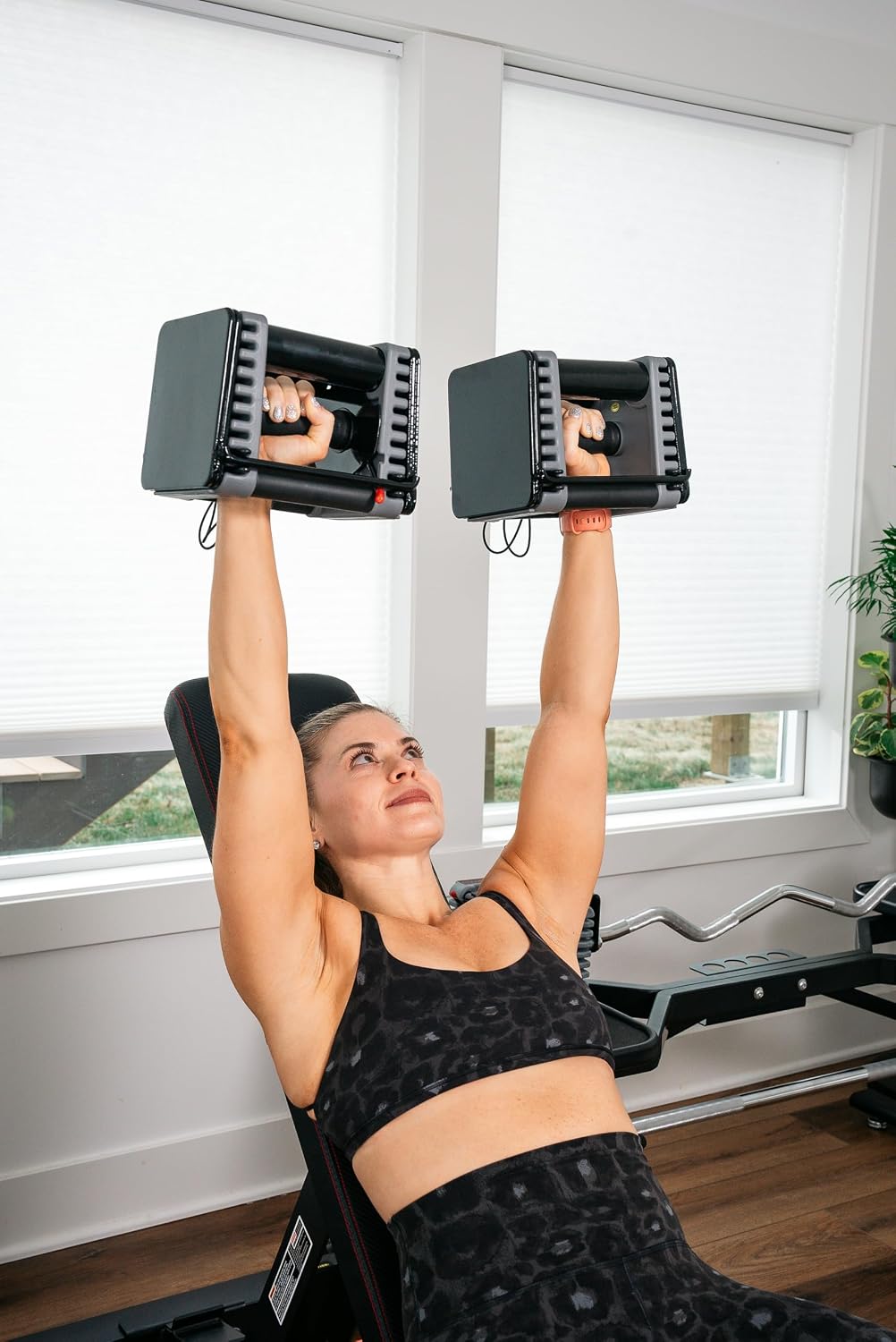
If you’ve ever tried to build a home gym, you’ve almost certainly hit this wall: you want the flexibility of a full dumbbell rack — weights that go from light warm-up sets all the way to heavy strength work — but you don’t have room (or budget) for 20 pairs of fixed dumbbells. That’s where adjustable dumbbells come in. An adjustable dumbbell is a single handle whose weight you can change in seconds using a dial, selector pin, or rotating collar. One pair sits on your shelf and replaces an entire rack. The premium end of this market — roughly $300 to $700 per pair — is dominated by three names that show up again and again in serious home gym conversations: PowerBlock, NuoBell, and Bowflex SelectTech. This guide breaks down exactly how they differ, where each one wins, and which one is right for your specific situation. No hype, no filler — just the tradeoffs laid out cleanly so you can decide.
| EDITOR'S PICKPowerBlock Elite USA 90 Pound A… | Mid-tierEisenlink Adjustable Dumbbell S… | Budget pickPowerBlock Elite EXP Adjustable… | |
|---|---|---|---|
| Weight range | 5-90 lb | 10-80 lb | 5-50 lb |
| Increments | — | 5 lb | — |
| Expansion | Stage 1-3 | — | Expandable |
| Adjustment | — | Quick-Lock | — |
| Sold as | Pair | ×2 | Pair |
| Weight type | — | Square | — |
| Price | $869.00 | $529.00 | $399.99 |
| See on Amazon → | See on Amazon → | See on Amazon → |
Why the Premium Tier Costs What It Does
Before diving into the head-to-head, it’s worth understanding why these products command $300–$700 when a set of fixed dumbbells at a discount retailer runs a fraction of that. The answer is engineering complexity and space efficiency.
A quality adjustable dumbbell has to lock weight plates or internal sliders securely at any increment, survive being set down (not gently placed) repeatedly, and resist the lateral stress that comes with exercises like lateral raises and rows. The selector mechanism — whether a dial, knob, or pin system — has to stay accurate after thousands of cycles. At the budget end, owners report mechanisms that feel loose after six months. At the premium end, the tradeoff you’re paying for is durability and reliable locking under load.
According to Wirecutter’s “The Best Adjustable Dumbbells” guide (updated 2025), selector reliability and weight-increment granularity are the two factors that most separate premium models from mid-market alternatives. Both matter enormously for serious training — a locking failure mid-set is a safety issue, and crude 5-pound jumps make progressive overload (gradually adding weight to keep getting stronger) harder to execute precisely.
ACE Fitness, in their “Home Gym Equipment Essentials” resource page, consistently rates adjustable dumbbells among the highest return-on-investment single purchases for space-constrained training environments — and at these price points, you’re buying something you should expect to use for a decade.
The Three Contenders at a Glance
Here’s a quick snapshot before the deep dive:
| Model | Weight Range | Increment | Approx. Price (per pair, 2026) | Shape |
|---|---|---|---|---|
| PowerBlock Elite EXP (Stage 1) | 5–50 lb | 2.5–5 lb | ~$330–$370 | Block/cage |
| NuoBell 80 lb | 5–80 lb | 5 lb | ~$500–$550 | Traditional |
| Bowflex SelectTech 552 | 5–52.5 lb | 2.5–5 lb | ~$300–$380 | Traditional |
Prices are based on observed retail averages as of May 2026. The Bowflex 552 in particular is price-volatile — Barbend’s “Best Adjustable Dumbbells” roundup (2025) flagged it as the most frequently discounted model in the category, often dropping $40–$80 during major sale windows.
PowerBlock Elite EXP: The Workhorse That Grows With You
Who It’s For and How It Works
PowerBlock has been in this category since the early 1990s and has the track record to prove it. The Elite EXP uses a pin-selector system — a small metal pin you pull out, slide to your chosen weight slot, and push back in. It’s the same concept as a weight-stack cable machine at a commercial gym, just miniaturized.
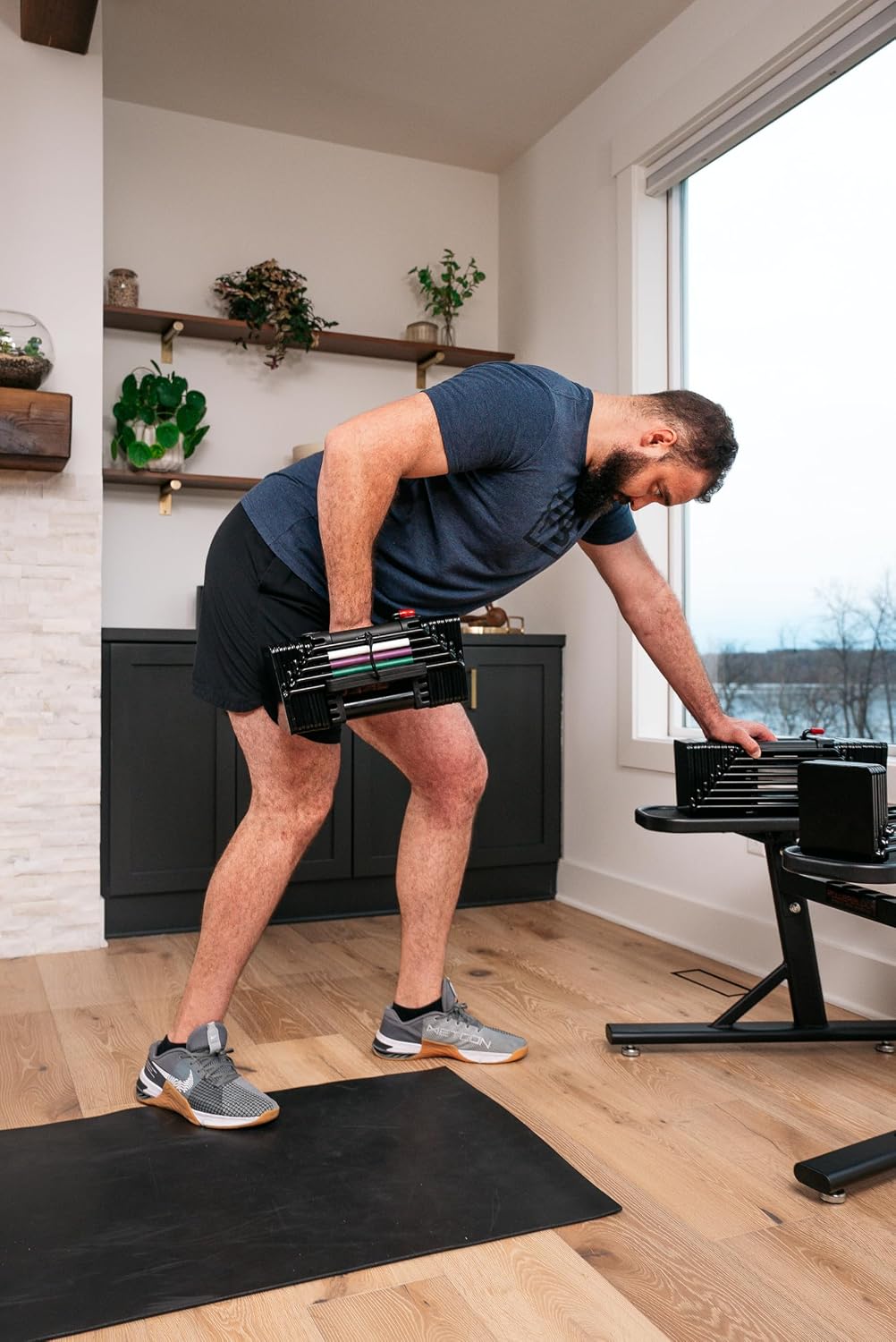
The defining characteristic of the PowerBlock is its block shape: instead of a traditional cylindrical dumbbell, the weight sits in a square cage around your hand. Owners either love this or find it awkward for certain exercises. Movements like hammer curls and neutral-grip pressing work naturally. Wide-grip exercises and anything requiring the dumbbell to rest against your leg (like a dumbbell row setup) can feel slightly more restricted due to the cage geometry.
Where PowerBlock Wins
- Expandability. The Elite EXP is a modular system. You buy Stage 1 (5–50 lb), and if your training progresses, you can purchase add-on kits to extend the same handles to 70 lb or 90 lb. You’re not buying a new product as you get stronger — just an expansion.
- Compact footprint. The block design makes these the smallest-format adjustable dumbbell at any given weight ceiling. For garage gyms with limited floor space, this matters.
- Durability consensus. Barbend’s “Best Adjustable Dumbbells” roundup (2025) notes the pin selector as one of the more failure-resistant mechanisms in the category over time. Owners who have used PowerBlocks for 5–10 years consistently report it staying solid.
- 2.5-lb micro-increments at lower weights. Useful for shoulder rehab and precise progressive overload.
Where PowerBlock Loses
- The cage design is polarizing. If you do a lot of exercises where the bell rests on your thigh, the square cage can dig in uncomfortably.
- The pin system requires two hands to adjust and is slower than a dial or collar mechanism.
- Stage 1 tops out at 50 lb, which limits heavy rows or goblet squats. The expansion kit solves this but adds cost.
Best for: Lifters who want long-term expandability, coaches outfitting small studios, and anyone prioritizing durability above all else.
Eisenlink
$529.00
In stock on Amazon
Check price on AmazonNuoBell 80 lb: The Premium Generalist With Real Heavy-End Range
Who It’s For and How It Works
NuoBell (made by Core Home Fitness) arrived in the premium market more recently but has made a strong impression, particularly because of its traditional dumbbell shape and its unusually high weight ceiling of 80 lb per dumbbell.
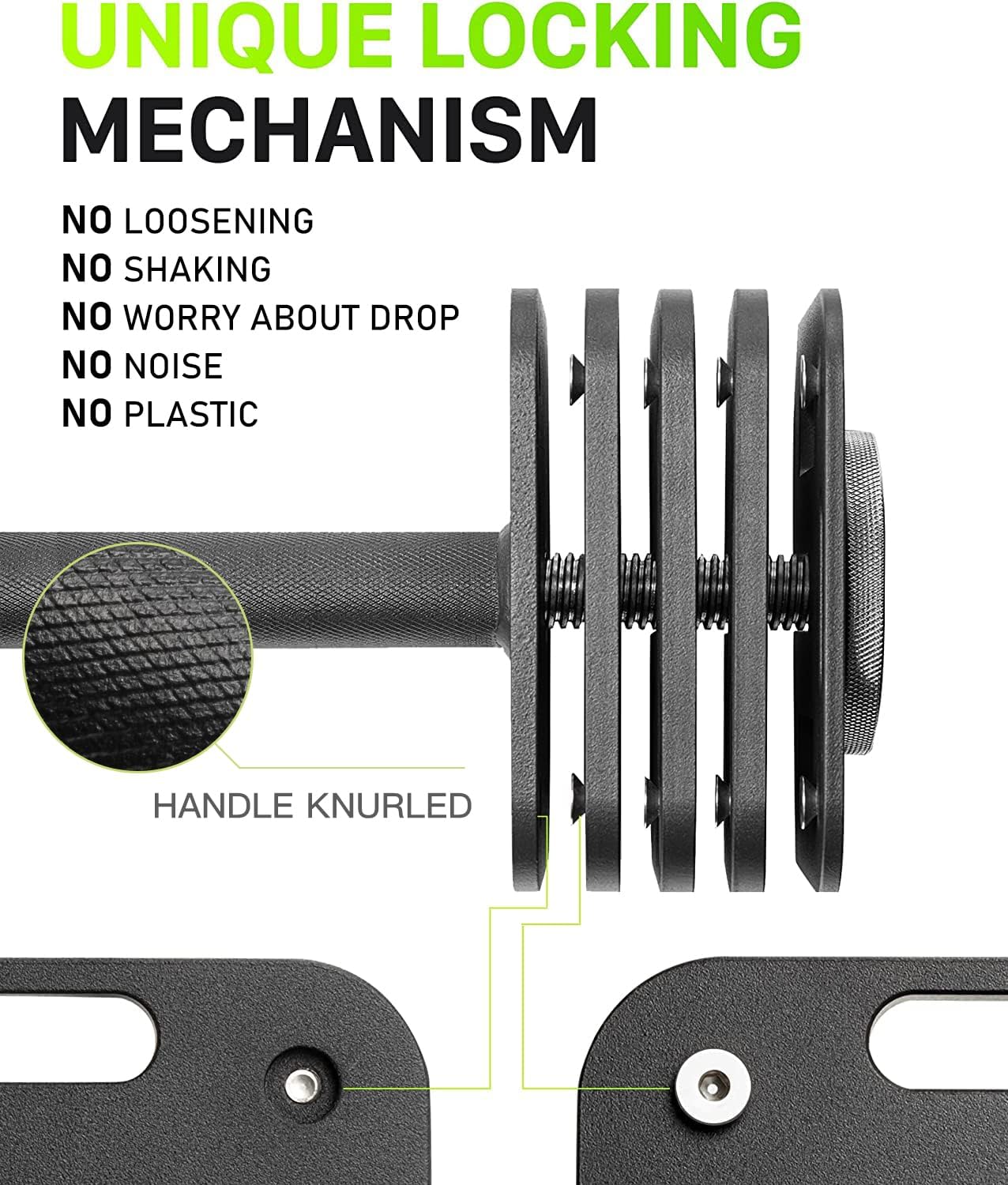
The NuoBell uses a rotating collar mechanism — you turn the handle collar to select your weight. The result is a weight-adjustment experience that owners describe as more intuitive for people accustomed to traditional dumbbells, and it can be operated one-handed once you’re familiar with it.
Where NuoBell Wins
- 80 lb ceiling in a traditional shape. This is the standout specification in this comparison. If you’re doing heavy Romanian deadlifts, dumbbell rows, Bulgarian split squats, or goblet squats, the ability to go to 70–80 lb in an adjustable dumbbell is rare. Men’s Health’s “Best Adjustable Dumbbells” gear review (2025) specifically called out the NuoBell 80 as one of the few adjustable options that doesn’t cap out before advanced lower-body and back movements.
- Exercise compatibility. Because it looks and feels like a traditional hex dumbbell, it works naturally with every exercise — no geometric awkwardness. You can rest it on your thigh, grip it wide, and use it for floor exercises without issue.
- One-handed adjustment. The collar rotation is faster for many users than a pin system.
Where NuoBell Loses
- Price. At ~$500–$550 per pair, the NuoBell 80 is the most expensive option in this comparison. You’re paying a real premium for the 80 lb ceiling and traditional shape.
- 5-lb increments only. Unlike the PowerBlock’s 2.5-lb micro-increments at lower weights, NuoBell jumps in 5-lb steps throughout. For lighter accessory work where precision matters, this is a genuine limitation.
- No expansion path. What you buy is what you have.
- Shorter track record. Consumer Reports’ home gym equipment buyer’s guide (2025) flagged this as a consideration for buyers prioritizing long-term investment value — the brand doesn’t yet have the multi-decade durability data that PowerBlock does.
Best for: Stronger lifters who need 60–80 lb per hand, anyone who dislikes the block-cage format, and those willing to pay for a product they genuinely won’t outgrow.
PowerBlock
$869.00
In stock on Amazon
Check price on AmazonBowflex SelectTech 552: The Entry Point to Premium
Who It’s For and How It Works
The Bowflex SelectTech 552 is arguably the product that introduced most home gym builders to adjustable dumbbells. The dial selector at each end is intuitive — turn the dial to your chosen weight, lift the dumbbell out of the cradle, and go. It has a traditional cylindrical feel and the fastest weight-change mechanism in this group.
Where Bowflex Wins
- Price accessibility. At $300–$380 per pair and frequently discounted, it’s the least expensive path into premium adjustable dumbbells. Wirecutter’s “The Best Adjustable Dumbbells” guide has consistently recommended it as the best pick for most people precisely because of this value-to-performance ratio.
- Fastest selector mechanism. The dual-end dials allow rapid weight changes — genuinely useful in circuit training where you’re moving between exercises with different loads.
- Traditional shape. Like the NuoBell, it has a conventional feel in the hand and works naturally across exercises.
- 2.5-lb fine increments at lower weights, matching the PowerBlock’s precision at the lighter end.
Where Bowflex Loses
- 52.5 lb ceiling. This is the most significant limitation for serious lifters. If your heavy dumbbell exercises require 60 lb or more, the 552 is already at its limit. Bowflex makes the SelectTech 1090 (tops out at 90 lb), but that’s a different price tier at roughly $600–$700 per pair.
- Durability is the recurring concern. Across owner reviews compiled in Barbend’s “Best Adjustable Dumbbells” roundup (2025), the SelectTech dial mechanism is the most frequently reported failure point in the premium adjustable category. Not universal — many owners use them for years without issue — but it’s a known pattern. Barbend explicitly cites this as the main reason it recommends PowerBlock to heavier users despite the higher price of comparable weight ranges.
- Bulky cradle. The SelectTech sits in a large plastic tray that takes up meaningful shelf or floor space.
The Bowflex 1090 consideration: If you need heavy-end range but prefer the Bowflex dial system, the 1090 competes in the 90 lb tier at a similar price to the NuoBell 80. The same durability caveats apply — the dial mechanism is a known maintenance point regardless of the model.
Best for: Lifters whose heaviest exercises stay in the 5–52.5 lb range, those prioritizing fast weight changes for circuit-style training, and anyone working within a tighter budget.
PowerBlock
$399.99
In stock on Amazon
Check price on AmazonThe Decision Framework: Which One Is Actually Right for You
The tradeoffs collapse into clear rules when you apply them to your actual training:
If your heaviest exercises top out around 50 lb per hand — most upper-body pressing, curls, lateral raises, moderate rows — and you want the best long-term durability with room to grow, the PowerBlock Elite EXP Stage 1 is the smart pick. The expandability means you’re not backed into a corner if your strength progresses, and the durability track record is the strongest in this field.
If you need 60–80 lb per hand for heavy rows, split squats, or goblet squats, and you want a traditional dumbbell feel, the NuoBell 80 is the only product in this comparison that genuinely solves the problem. Yes, it’s the most expensive — but it’s also the only one you won’t outgrow at intermediate-to-advanced loading levels.
If your budget ceiling is around $350 and you’re working in the 5–52.5 lb range for the foreseeable future, the Bowflex SelectTech 552 offers excellent value and the fastest weight-change experience in the category. Accept that the mechanism is more maintenance-sensitive than the other two, and avoid dropping these — the plastic selector components don’t tolerate impact well.
If you’re a trainer outfitting a small studio where durability over thousands of client sessions is the primary concern, PowerBlock’s commercial track record makes it the defensible choice. The modular expansion means you can add weight range as your client base demands without replacing the whole set.
The decision math consistently favors buying the right tool for your actual training rather than the cheapest option you’ll outgrow in 18 months. As Wirecutter’s “The Best Adjustable Dumbbells” guide frames it, the right adjustable dumbbell is the one whose weight range and mechanism you’ll still be satisfied with three to five years from now.
The Bottom Line
There’s no universally “best” premium adjustable dumbbell — there’s the best one for your weight range, your exercises, and how much long-term flexibility you need. PowerBlock for durability and expandability. NuoBell for heavy range and traditional feel. Bowflex for value at the moderate weight tier. Match the spec to your training, not the other way around, and you’ll have a tool that earns its shelf space for years.