July 15, 2026 • Brian Webb • 11 min reading time • Prices verified June 29, 2026
Foam Roller Size Guide: When 13 Inches Is Enough and When You Need 24 or 26
A foam roller is exactly what it sounds like: a cylinder of dense foam — sometimes smooth, sometimes textured with ridges or bumps — that you use to apply pressure to tight muscles. You position it under a sore calf, hip, or back, and then slowly roll your body weight over it. That compression helps break up the tension in the connective tissue surrounding your muscles (a layer called fascia) and is widely used for warm-ups, cooldowns, and general recovery. The technique has a clinical name — self-myofascial release, or SMR — but the practical idea is simple: it’s a DIY deep-tissue massage you do on your own floor.
The part that trips people up is size. Walk into any sporting goods retailer (or scroll through one online) and you’ll see rollers ranging from pocket-sized 4-inch balls to 36-inch logs. The most common decision point lands between a 13-inch short roller and a 24- or 26-inch full-length roller — and the choice matters more than most buyers expect. This guide maps out exactly when each length makes sense, using published specs, aggregated owner feedback, and clinical sourcing to give you a clear decision before you spend a dollar.
| EDITOR'S PICKTriggerPoint Grid 2.0 Foam Roll… | Mid-tierTriggerPoint Grid 1.0 Foam Roll… | Budget pick321 Strong Foam Roller - Medium… | |
|---|---|---|---|
| Length | 26 in | 13 in | — |
| Weight capacity | 500 lb | — | — |
| Core type | Hollow | — | — |
| Density | Multi | Multi | Medium |
| Guide included | — | — | ✓ |
| Price | $74.99 | $29.99 | $27.78 |
| See on Amazon → | See on Amazon → | See on Amazon → |
Why Length Is the Specification That Actually Changes What You Can Do
Most buyers fixate on firmness — soft vs. hard — but length is the variable that determines whether a roller can physically do the job in the first place.
The core constraint is body-segment width. Your upper back, across the shoulder blades, is typically 14–18 inches wide for adults. To use a foam roller on your thoracic spine (the middle section of your back between your neck and lower back) effectively, you need a roller long enough to support both sides of your back simultaneously. If the roller is too short, one shoulder falls off the edge, your spine torques sideways, and you end up compensating in ways that undercut the whole exercise — and can stress joints that weren’t the target.
ACE Fitness, in their guide on foam rolling and self-myofascial release technique, specifically calls out the importance of stable, even contact along target muscle groups. A 13-inch roller simply cannot provide that bilateral support across the back for most adults.
A 24- or 26-inch roller can. Owners of the Amazon Basics 24-inch foam roller consistently point to this exact benefit — one reviewer described it as “works for bigger areas like your back without feeling too short,” which is the clearest possible summary of why length matters. That’s not a marketing point; it’s a biomechanical floor.
The 13-inch roller isn’t compromised — it’s specialized. For legs, calves, IT bands (the long strip of connective tissue running down the outside of your thigh), and targeted hip work, a short roller is not only adequate — it’s often preferable. It’s easier to control, fits under a calf precisely, and travels in a carry-on.
Here is where each length performs, by body segment:
| Body Area | 13-inch Short | 24–26-inch Full |
|---|---|---|
| Upper back / thoracic spine | ❌ Too narrow | ✅ Full bilateral support |
| Lower back (with caution) | ✅ Workable | ✅ Better stability |
| IT band / outer thigh | ✅ Precise | ✅ Either works |
| Calves | ✅ Ideal | ✅ Fine |
| Hamstrings | ✅ Workable | ✅ More stable |
| Glutes / piriformis | ✅ Good | ✅ Good |
| Travel / portability | ✅ Fits carry-on | ❌ Checked bag or leave behind |
The 13-Inch Case: Real Portability, Real Limits
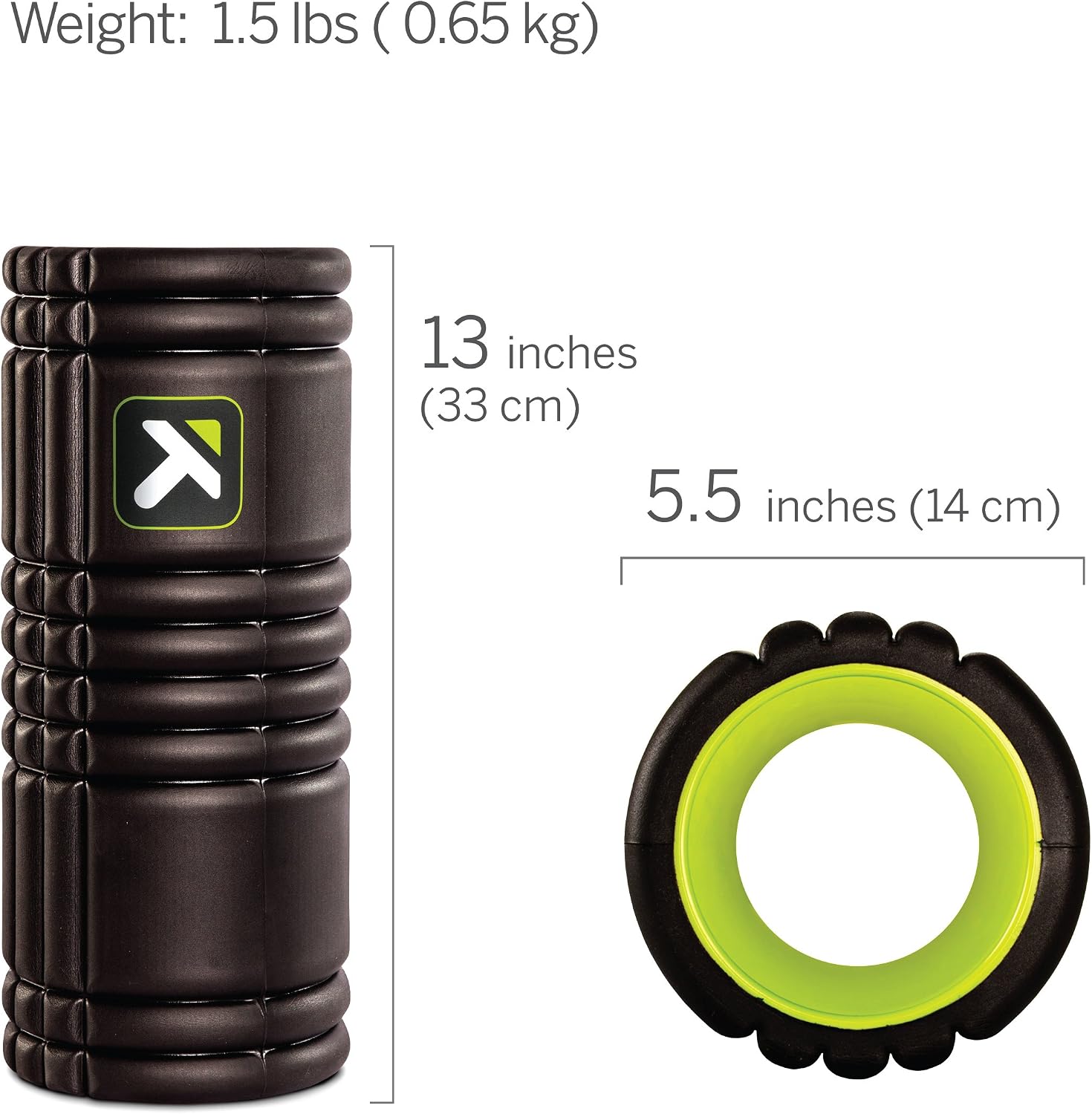
The TriggerPoint Grid 1.0 is the canonical short roller — 13 inches long, hollow-core construction (more on that below), and a surface texture that mimics the feeling of a massage therapist’s hands. Reviewers have labeled it a “must-have for lower back pain” and, notably, several owners report packing it for hiking retreats and travel training blocks. That’s the 13-inch value proposition in a sentence: it goes where a 26-inch roller cannot.
But the Grid 1.0 also generates one of the most instructive complaints in aggregated owner feedback. One reviewer specifically wished the roller were “3–4 inches wider” — a concrete dimensional complaint, not a softness complaint. That person wasn’t getting adequate back coverage. They weren’t using it wrong; the tool simply has a ceiling. Runner’s World’s gear coverage of foam rollers echoes this, noting that shorter rollers demand more user positioning skill on large muscle groups to avoid uneven contact.
The verdict on 13-inch rollers: If your primary targets are legs, calves, and single-muscle groups — and if travel or storage space is a real constraint — the short roller is a serious, not a compromised, choice. If back rolling is your main event, a 13-inch roller is going to frustrate you.
The 24–26-Inch Case: Full Coverage, Honest Tradeoffs
A full-length roller gives you the bilateral back support that the short roller cannot. It’s stable enough to lie on for thoracic extension work (a chest-opening stretch where you drape your back over the roller lengthwise), and it handles every leg movement a short roller can do with slightly more real estate to work with.
The Amazon Basics 24-inch roller earns consistent owner praise for back work specifically — and at an accessible price point, it’s often the first full-length roller in a home gym. Wirecutter’s foam roller coverage notes that a standard full-length roller is the default recommendation for most people precisely because of this versatility floor.
The TriggerPoint Grid 2.0 is the natural step up in the full-length category. Owner feedback includes a notable progression narrative — multiple reviewers describe upgrading to the Grid 2.0 from a softer, smoother roller as their training became more consistent. That upgrade pattern is meaningful: it tells you the Grid 2.0 is not a beginner’s impulse buy but a deliberate tool for someone who has built a rolling habit and wants more targeted pressure. Barbend’s equipment coverage positions the Grid line as a benchmark for textured rollers in the mid-market tier.
The OPTP PRO-Roller and the TriggerPoint CORE pull a different kind of owner — post-surgical patients and clinical users who specifically need softer, lower-pressure compression. Harvard Health Publishing’s overview of foam rolling benefits distinguishes between higher-density rollers suited for athletes with established tissue tolerance and softer options appropriate for recovery from injury or surgery. Both the OPTP and CORE show up repeatedly in that clinical context in owner reviews, which is useful signal: if you’re coming back from a procedure or dealing with hypersensitive tissue, full-length and soft is the combination to target.
The 321 Strong sits in interesting territory. Owners frequently mention that the surface looks more aggressive than it feels — described as “intimidating but even under the body.” That’s a useful data point if you’re nervous about textured rollers: the visual density of a grid surface doesn’t always translate to painful compression.
Hollow Core vs. Solid Core: The Durability Question You Should Ask Before You Buy
This deserves its own attention because it directly affects how long your roller stays firm.
A hollow-core roller — like the TriggerPoint Grid line — uses a rigid plastic tube at the center, with foam wrapped around it. The tube bears the structural load. The foam is primarily the contact and texture layer. Because the plastic core doesn’t compress, hollow-core rollers maintain their shape under repeated use far longer than solid-foam rollers.
A solid-core roller is foam all the way through. Under consistent load, solid foam eventually compresses, flattens, and loses its ability to deliver meaningful pressure. This is exactly why owners report rollers “going soft and flat after a few months” — that’s almost always solid-foam construction, not a defective product. It’s physics: foam under sustained compression fatigue will deform.
The practical implication: if you’re rolling daily or near-daily, the hollow-core construction is worth prioritizing. If you’re rolling twice a week for general maintenance, a quality solid-foam roller can last a reasonable lifespan before it needs replacing.
By the numbers:
- Hollow-core rollers typically maintain firmness for 3–5+ years of regular use (per manufacturer claims and aggregated long-run owner feedback)
- Quality solid EVA foam rollers often show compression fatigue within 6–18 months of daily use
- Price gap between solid and hollow-core at comparable sizes: roughly $15–$35
Smooth vs. Textured Surface: The Tradeoff Is Pressure, Not Quality
Neither smooth nor textured is objectively better. They’re different tools with different use cases.
Smooth-surface rollers distribute pressure evenly across a broader area of contact. This makes them gentler, which is appropriate for beginners who haven’t yet built tissue tolerance, for users with sensitive or post-surgical tissue, and for general warmup work where you want circulation without aggressive pressure. ACE Fitness’s self-myofascial release guide recommends beginning users start on smoother, lower-density surfaces to build tolerance before progressing.
Textured rollers — grids, ridges, knobs — concentrate pressure at specific contact points. The intent is to mimic trigger-point work and reach tissue that lies slightly deeper. The tradeoff is that the sensation is more intense. For experienced users with good tissue tolerance, this is a feature. For a first-time roller user, it can be off-putting enough to make them stop using the roller entirely — which defeats the purpose.
The practical decision rule: if you’ve never foam-rolled consistently before, start smooth and medium-density. You can always progress to texture. You cannot untrain the aversion that comes from starting too aggressively.
Frequently Asked Questions
Is a 13-inch foam roller enough for rolling out your back? For most adults, no — not for upper back and thoracic spine work. The 13-inch length is narrower than the average adult’s shoulder width, which means bilateral support collapses on one side. Short rollers work well for targeted leg and calf work, but if back rolling is your priority, a 24–26-inch roller is the functional minimum.
What is a hollow core foam roller and does it stay firm longer? A hollow-core roller has a rigid plastic tube running through its center, with foam on the outside. Because the structural load is borne by the tube rather than the foam, hollow-core rollers resist compression fatigue significantly longer than solid-foam rollers. They do stay firm longer — consistently so, across aggregated long-run owner reports.
Should a beginner start with a soft or medium density roller? ACE Fitness’s foam rolling guidance recommends softer or medium-density rollers for new users. Starting too firm can make rolling feel punishing, which reduces the likelihood you’ll stick with it. Build the habit on a forgiving surface first, then graduate to firmer options as your tissue adapts.
Can I use a short travel roller as my only foam roller? It depends entirely on what you’re rolling. If your routine is focused on legs, IT bands, calves, and targeted hip work — yes, a 13-inch roller can serve as your only roller. If you want to roll your thoracic spine and upper back with any consistency, a short roller alone will leave a real gap.
Why does my foam roller go soft and flat after a few months? Almost certainly solid-foam construction. Without an internal rigid core, foam under repeated body-weight compression will eventually deform and lose its rebound. This isn’t a defect — it’s an inherent limitation of solid-foam materials. The fix is to choose a hollow-core roller if longevity under daily use matters to you.
What is the difference between a smooth and a textured foam roller surface? Smooth rollers distribute pressure broadly and gently — better for beginners and sensitive tissue. Textured surfaces (grids, ridges, knobs) concentrate pressure to create more specific, intense stimulation that experienced users associate with deeper tissue work. The surface that looks more aggressive isn’t always more effective — it’s more targeted. Match the surface to your current tissue tolerance, not to how serious you want to appear.
The Decision Rule
Run through this in order:
- If back rolling is a primary goal → buy a 24- or 26-inch roller. Full stop. Nothing shorter will do the job reliably.
- If you travel frequently and leg/calf work is the priority → a 13-inch hollow-core roller like the TriggerPoint Grid 1.0 is a legitimate, purpose-built choice.
- If you’re brand new to rolling → start smooth and medium-density, full length. The Amazon Basics 24-inch is a low-risk entry point.
- If you’ve been rolling consistently and want more intensity → the TriggerPoint Grid 2.0 is the upgrade owners repeatedly describe in exactly that context.
- If you’re in post-surgical or high-sensitivity recovery → full-length and soft (OPTP PRO-Roller or TriggerPoint CORE) is the combination the clinical-user feedback consistently points toward.
- If you want one roller to do everything at home → 24–26-inch, medium to firm, hollow-core construction. That combination handles the widest range of use cases without compromise.
The size decision doesn’t need to be complicated. It just needs to match what you’re actually going to roll.