August 30, 2026 • Brian Webb • 10 min reading time • Prices verified June 29, 2026
Budget Adjustable Dumbbells Under $200: The Lesser-Known Brands Closing the Gap on Bowflex
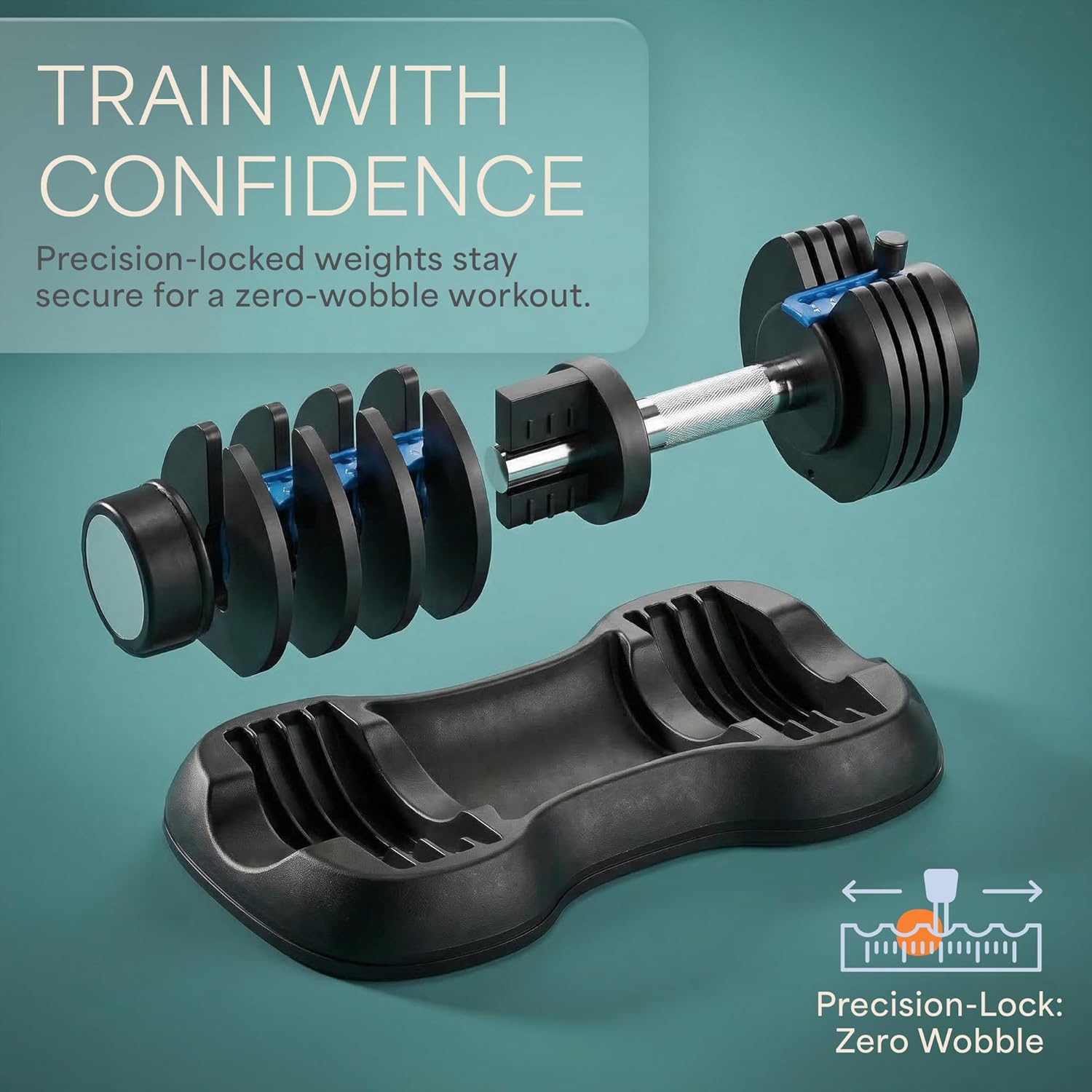
Adjustable dumbbells — a single piece of equipment that replaces an entire rack of fixed-weight dumbbells by letting you change the resistance level in seconds — have become the centerpiece of the modern home gym. The idea is simple: instead of buying eight separate pairs of dumbbells at different weights (which gets expensive and takes up a lot of floor space), you buy one adjustable set and dial, pin, or twist it to whatever weight you need for the exercise at hand. The problem has always been price. Bowflex SelectTech 552s, the set that essentially defined the category for home gym owners, typically run $350–$400. For a lot of people building a home gym in 2026, that’s the whole equipment budget right there. The good news is that a cluster of lesser-known brands — AOTOB, LifePro, PIRIER, Eisenlink, CAP Barbell, and Rendpas among them — have pushed seriously into the sub-$200 space, and the owner feedback is more compelling than you’d expect.
This guide synthesizes what real owners report, does the price-per-pound math that budget buyers are already doing themselves, and gives you a clear framework for deciding whether a sub-$200 set belongs in your build — or whether stretching to a premium tier is actually the smarter play.
The Price-Per-Pound Lens: Why Budget Buyers Are Doing Their Own Math
When you’re evaluating adjustable dumbbells, the most honest comparison tool isn’t the sticker price — it’s price per pound of usable weight. A $400 set that goes up to 52.5 lbs per dumbbell costs roughly $3.80 per pound. A $200 set that tops out at 55 lbs per dumbbell cuts that nearly in half.
AOTOB owners, in particular, are already running this calculation themselves and citing it as the core reason for the purchase. Across aggregated review patterns, buyers consistently land at approximately $2.20 per pound for AOTOB sets and frame it explicitly as a value argument against Bowflex and PowerBlock — not as settling for less, but as a deliberate cost-efficiency decision. Wirecutter’s adjustable dumbbell coverage confirms that price-per-pound is the most defensible budget metric because it normalizes for the wide variation in max weight across sets.
By the numbers:
| Set (approximate market tier) | Typical street price | Max weight per DB | Est. price per pound |
|---|---|---|---|
| Bowflex SelectTech 552 | ~$375 | 52.5 lbs | ~$3.57/lb |
| AOTOB 55 lb set | ~$120 | 55 lbs | ~$2.18/lb |
| Eisenlink 50 lb set | ~$160 | 50 lbs | ~$3.20/lb |
| LifePro 50 lb set | ~$180 | 50 lbs | ~$3.60/lb |
Prices reflect observed 2026 market conditions; verify current pricing before purchase.
For a first-time home-gym builder or a couple buying two separate sets (a purchase pattern that comes up repeatedly in Rendpas and AOTOB reviews, because low unit cost makes it financially possible), the math changes the decision entirely.
The Real Trade-Offs by Brand: What Owners Are Actually Flagging
AOTOB is where the value case is strongest on paper, and owner consensus largely holds it up. Reviewers consistently praise the price-per-pound ratio and note that the weight increments feel appropriate for progressive training (the process of gradually increasing weight to keep challenging your muscles). The pattern worth noting: buyers who purchase two sets for couples cite AOTOB specifically — the low unit price makes owning two independent sets feasible where Bowflex pricing would force sharing. BarBend’s buying guide coverage of the budget dumbbell category corroborates that AOTOB sits at the high end of value efficiency in this tier.
LifePro sits in an interesting position. Owners consistently give it four stars — and then explicitly explain why they’re withholding the fifth. The recurring phrase across reviews is some version of “waiting to see how it holds up.” That’s not a condemnation; it’s a rational signal from buyers who are happy with current performance but haven’t stress-tested long-term durability. ACE Fitness’s equipment safety guidelines note that plastic selector components on adjustable dumbbells do have a finite fatigue life — which is the honest mechanical reason LifePro’s cautious reviewers are right to flag it rather than dismiss it.
PIRIER gets a specific durability mark in its favor — the twist-collar adjustment mechanism (a rotating ring that locks weight plates at a chosen position) is praised for being fast once learned. The qualifier matters: once learned. Multiple reviewers note a genuine learning curve with the twist system. The first week, it feels clunky. After that, owners report it’s among the faster adjustment methods in this price tier. If you’re circuit training — moving between exercises quickly with minimal rest — the speed advantage is real, but don’t assume it out of the box.
CAP Barbell is a brand with genuine legacy in the iron industry, and its adjustable sets benefit from that manufacturing heritage. The owner flag here is similar to PIRIER’s: the adjustment mechanism requires a specific rebalancing step that isn’t intuitive until you read the instructions carefully. Reviewers who skipped the manual are the ones who leave frustrated reviews. Reviewers who took ten minutes to learn the system are consistently happy. Men’s Health’s home gym coverage has noted CAP as a reliable mid-budget option precisely because of that manufacturing background, though they share the caveat about the learning curve.
Eisenlink is the outlier in adjustment style — it uses a pin-lock system rather than a dial or twist collar. A pin-lock means you physically insert a pin to select your weight, similar to a selectorized weight stack at a commercial gym. Owners who switched to Eisenlink from dial-style systems specifically praise the durability trade-off: fewer moving plastic parts means fewer points of failure. The secondary benefit that owners flag — and this one shows up enough to be credible — is the square plate shape. Square plates don’t roll when set on the floor. That’s not a marketing claim; it’s physics, and the owners treating it as a genuine safety and convenience feature are right to do so. The square shape also makes the dumbbell more stable during exercises like renegade rows where the weight is planted on the floor.
Rendpas follows the couples-purchase pattern of AOTOB — the low price point makes buying two sets a real option, and reviews skew toward dual-purchasers setting up a shared home gym. Owner feedback is broadly positive on build quality for the price, with the same lingering durability-at-12-months question that follows the category generally.
Do Budget Sets Actually Work for Serious Training?
The honest answer from aggregated owner data is: yes, with conditions. Consumer Reports’ home gym survey analysis found that satisfaction with budget fitness equipment correlates most strongly with alignment between intended use and actual capability — which is a polite way of saying that buyers who expected budget dumbbells to perform identically to Bowflex and were disappointed are often buyers who used them differently than intended.
For the use cases where sub-$200 sets genuinely deliver:
- Hypertrophy training (building muscle through volume — meaning more sets and reps at moderate weight) works well across all the brands above. Most top out at 50–55 lbs, which covers the working weight for most upper-body exercises for intermediate lifters.
- Couples or roommates with different strength levels sharing one set works logistically — the incremental adjustment lets a 135-lb person and a 195-lb person use the same unit in the same session. The friction point is that only one person can use it at a time; for simultaneous training, the dual-set purchase makes more sense.
- Circuit training with fast transitions is where adjustment speed becomes a real differentiator. The PIRIER twist system and Eisenlink pin-lock both get favorable marks here once the user is past the learning curve. Dial systems — which Bowflex popularized — can feel slower during rapid-fire transitions.
Where the premium sets justify their price:
- Heavy compound work above 55 lbs per hand. Most sub-$200 sets cap here. If you’re progressing toward serious dumbbell work — heavy dumbbell presses, Romanian deadlifts, rows with substantial resistance — you’ll hit the ceiling.
- Long-term durability certainty. The five-star-withholding pattern among LifePro and AOTOB buyers is an honest signal. Bowflex has a documented service network and replacement parts. The budget brands are newer entrants, and multi-year failure data is thinner. Wirecutter’s adjustable dumbbell analysis specifically cites parts availability and manufacturer support as key differentiators at the premium tier.
Frequently Asked Questions
Are plastic adjustment components on budget dumbbells a real long-term problem? It’s a legitimate concern, not paranoia. ACE Fitness’s equipment safety guidelines acknowledge that plastic selector mechanisms have finite fatigue cycles, and the honest owner reviews — especially on LifePro — reflect exactly this: satisfaction now, uncertainty about year two and three. The brands using fewer plastic moving parts (Eisenlink’s pin-lock system, for instance) have a mechanical advantage in durability, at least in theory. The practical answer is: if you’re training five or six days a week at high volume, plan for the possibility of replacement parts or a set upgrade in two to three years.
Do budget adjustable dumbbells rattle or clank during exercises? Yes, to varying degrees — and this is true of the category broadly, not just budget sets. Loose plate tolerances create noise during movement. Owner feedback on AOTOB and Rendpas notes some clank, particularly at lighter settings where fewer plates are engaged. This is annoying but not structurally dangerous. If noise is a dealbreaker (apartment training with thin floors, early-morning sessions), it’s worth factoring in.
What is the maximum weight available in budget adjustable sets under $200? Most sub-$200 sets cap at 50–55 lbs per dumbbell. A small number of sets reach 71.5 lbs, but those typically push the $200 ceiling or slightly above depending on market timing.
Is a pin-lock or dial adjustment faster for circuit training? Once both systems are learned, pin-lock (Eisenlink) and twist-collar (PIRIER) are comparably fast for most users. Dial systems tend to be slightly slower because they require more deliberate rotation. The real variable is familiarity: any system you’ve used for a month will feel faster than any system you learned yesterday.
Do square-plate dumbbells actually prevent rolling or is that marketing? It’s real. Square plates don’t roll on a flat floor. For exercises like renegade rows or push-ups with dumbbells where the weight is planted, this is a genuine safety and stability feature, not just marketing copy. Eisenlink owners who comment on it are not imagining the benefit.
Can two people with different strength levels share one adjustable dumbbell set effectively? Logistically, yes — adjustable sets are designed for exactly this. The practical limit is that only one person trains at a time. For partners who train simultaneously, the price-per-pound math on AOTOB and Rendpas makes buying two separate sets financially reasonable in a way that Bowflex pricing typically doesn’t.
The Decision Framework
If you’re brand new to home training and want to spend under $150: AOTOB is the starting point. The price-per-pound math is the strongest in the category, owners are broadly satisfied, and the durability question is the known trade-off you’re accepting.
If you’re circuit training and need fast adjustments: Give PIRIER serious consideration, but commit to the learning curve in week one. After that, the twist system earns its reviews.
If durability of the adjustment mechanism is your primary concern: Eisenlink’s pin-lock design has fewer plastic failure points, and the square-plate rolling prevention is a genuine secondary benefit.
If you’re buying for two people training simultaneously: Run the math on two budget sets versus one premium set. At AOTOB or Rendpas prices, two independent sets often cost less than one Bowflex SelectTech 552 pair — and both people can train at the same time.
If you’re regularly training above 50 lbs per hand or need long-term durability certainty with manufacturer support: The budget tier is the wrong tier. Stretch to Bowflex SelectTech or PowerBlock, where parts, service, and documented owner experience exist at scale. BarBend and Wirecutter both consistently recommend this stretch for serious long-term builds.
The sub-$200 market has genuinely closed the gap on Bowflex for the majority of home gym use cases. The gap that remains — parts availability, max weight ceiling, long-term failure data — is real, not marketing. Know which side of that gap your training lives on, and the decision becomes straightforward.