August 9, 2026 • Brian Webb • 10 min reading time • Prices verified June 29, 2026
Adjustable Dumbbells Under $150: The Budget Tier Buyers Who Skip Bowflex Are Choosing
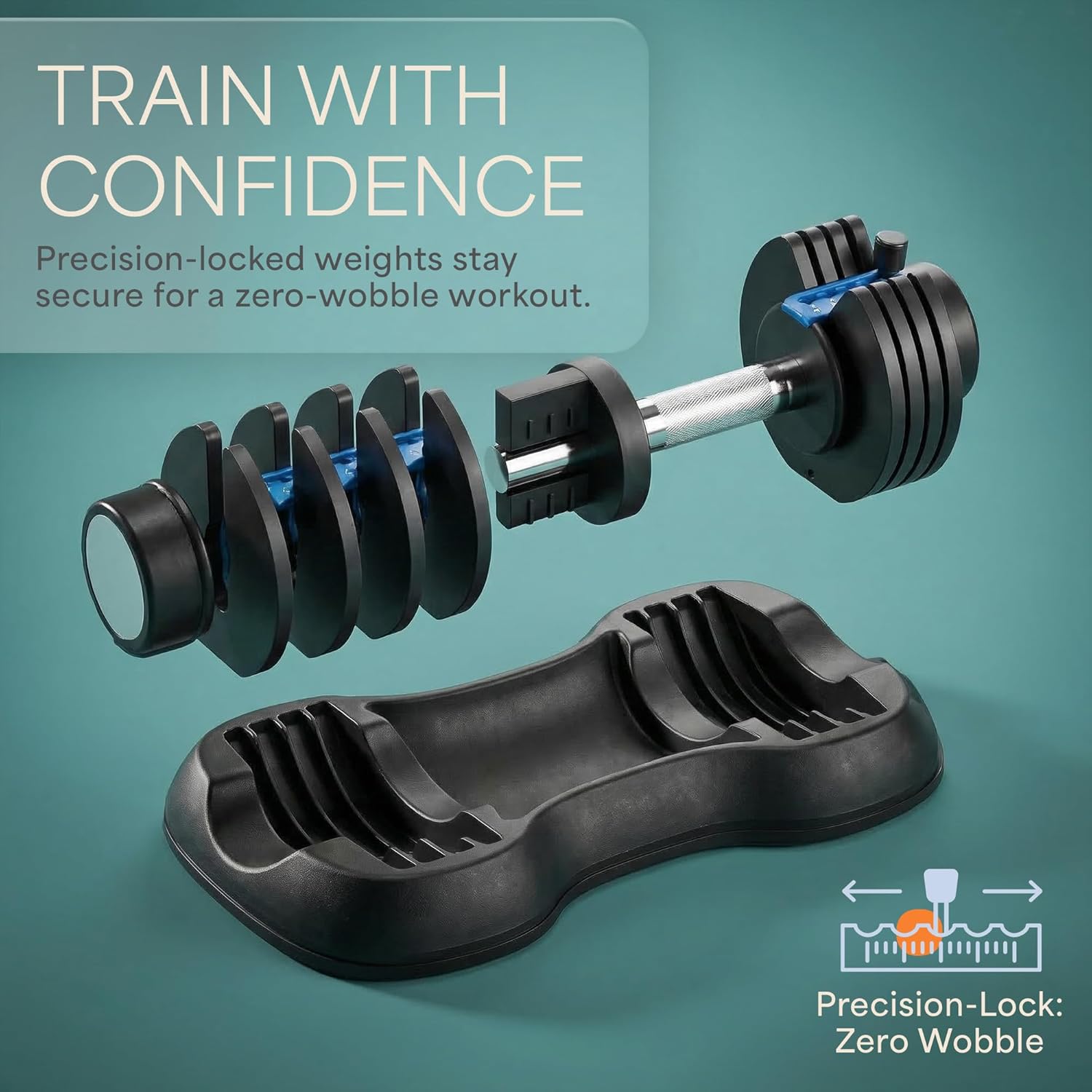
Adjustable dumbbells are exactly what they sound like: a single dumbbell handle — the short bar you grip — that can hold different amounts of weight depending on how you configure it, replacing a whole rack of separate fixed weights. Instead of buying ten individual dumbbells and finding somewhere to store them all, you buy one pair of adjustable dumbbells and swap the weight up or down as your workout demands. For anyone setting up a home gym in a spare room, garage, or apartment, that’s a significant convenience. The question this guide answers is simple: if you’re not willing (or not yet ready) to spend $400–$500 on a Bowflex SelectTech 552 — the name that comes up constantly in this category — what are you actually choosing between at the under-$150 price point, what are you giving up, and how do the best options in this tier compare on the things that matter most?
Let’s dig in.
How Buyers in This Tier Are Actually Thinking About Price
The sub-$150 adjustable dumbbell market has a specific buyer psychology that’s worth naming directly: these are not uninformed shoppers defaulting to whatever is cheapest. Reviews and owner forums consistently surface deliberate comparison shoppers who have looked at the Bowflex, done the math, and made a calculated decision.
One pattern shows up repeatedly: buyers computing a price-per-pound figure — dividing the total cost by the top weight capacity — and using it as a primary comparison metric. At roughly $2.20 per pound, AOTOB adjustable dumbbells land well below premium brands that owners describe as costing “double to quadruple” per pound. A CAP Barbell buyer frames the value decision bluntly in reviews: “I’m not gonna shell out $500” — and positions what they bought as delivering around 80% of a Bowflex’s functional utility.
By the numbers:
| Tier | Approximate price | Top weight (per dumbbell) | Approx. price per pound |
|---|---|---|---|
| Budget (AOTOB, CAP, LifePro) | $80–$150/pair | 25–52.5 lbs | $1.80–$3.00/lb |
| Mid-market (Bowflex 552) | ~$350–$400/pair | 52.5 lbs | ~$3.50–$4.00/lb |
| Premium (PowerBlock Elite EXP) | $500+/pair | 70–90 lbs | $3.50–$5.00/lb |
Per Barbend’s “Best Adjustable Dumbbells” buyer guide (2025 edition), the price-per-pound metric is a useful starting signal but needs to be contextualized against mechanism type, durability track record, and the weight increments the dumbbell actually offers — all of which vary significantly in this tier.
The honest framing: if you’re an intermediate or advanced lifter who regularly moves 50+ pounds and trains frequently, the budget tier will frustrate you. If you’re a beginner building consistency, or a secondary-user in a household gym, the math can genuinely work in your favor.
The Three Things That Separate Budget Adjustables From Each Other
Once you’re inside this price band, all the options share one limitation: they’re not Bowflex. What separates the good ones from the mediocre ones comes down to three variables.
1. Mechanism type: pin vs. dial vs. stand-and-turn
Pin/collar mechanisms are the oldest and most straightforward design. You pull a pin, slide a selector, and re-lock. The upside is that they tend to be mechanically simple and don’t have small plastic dial parts that can wear out. The downside is that weight changes typically take 15–30 seconds — slower than premium dials.
Dial mechanisms — the approach Bowflex made famous — let you turn a wheel at each end of the handle to select a weight increment. The mechanism is satisfying and quick, but in budget versions, owner reviews across multiple products flag a higher rate of plastic component wear compared to all-metal alternatives.
Stand-and-turn systems — used by brands like PIRIER in this tier — let you set the dumbbell in a cradle, turn the handle to your desired weight setting, and lift. Owners who have used this system describe it as genuinely intuitive once you understand the mechanism, and it reads as a beginner win precisely because the motion is direct. One PIRIER owner in aggregated reviews describes it as feeling natural “from the first set.”
2. Bar material: the structural transparency signal
This is where buyers get serious. LifePro adjustable dumbbells earn consistent praise in owner reviews specifically because the metal bar running through the dumbbell is visually obvious — you can see the structural core. At a price point where buyers are reasonably worried about weights coming apart mid-lift, that visible metal bar is meaningful.
The concern is legitimate. Several budget adjustable sets use plastic-core construction or partially plastic handles. When you’re pressing weight overhead or doing a Romanian deadlift, the last thing you want is a credible question about structural integrity. Owners who explicitly chose LifePro over competitors regularly cite this feature as the deciding factor — not marketing copy, but a real design choice that signals “this won’t fail on me.”
Per Men’s Health’s “Best Adjustable Dumbbells” comparison (2025), construction quality at the handle and the locking mechanism are the two most consequential factors in long-term adjustable dumbbell reliability.
3. Grip width: the close-grip problem
This is the most under-discussed limitation in the budget tier, and it affects exercise selection in a real way. Adjustable dumbbells are necessarily wider than fixed dumbbells of the same weight — the mechanism that holds the weight plates has to sit somewhere. In most budget sets, this is manageable. In some, like the Rendpas, owners specifically call out the grip width as making close-grip exercises — skull crushers, close-grip presses, specific curl variations — noticeably awkward.
If close-grip pressing or tricep-focused dumbbell work is a core part of your program, grip width deserves a specific look before you buy. ACE Fitness’s “Resistance Training for Beginners” overview notes that exercise variety and full range of motion are particularly important for beginner programs building foundational movement patterns — a point that makes grip width a functional concern, not just an ergonomic preference.
Honest Limitations of the Sub-$150 Tier
One of the most instructive signals in buyer reviews for Amazon Basics adjustable dumbbells is a recurring wish: “I want a 50-pound version.” That wish is diagnostic. It reveals a ceiling frustration that is entirely predictable: buyers who start in this tier and train consistently for six to twelve months often find themselves hitting the maximum weight on their set and having nowhere to go.
The ceiling issue is real. Most under-$150 adjustable sets top out between 25 and 52.5 pounds per hand. For a beginner, 25 pounds is a reasonable training ceiling for months. For someone who has been lifting seriously for a year or two, it’s inadequate for lower-body pressing and many compound movements.
Per Consumer Reports’ “Home Gym Equipment Ratings and Reviews,” buyers most commonly report wanting more weight range as they progress — and that limitation is a genuine structural constraint of this price band, not something that better design can fix at this cost.
The honest version of the budget-tier value proposition: You are buying time. A sub-$150 set can carry a beginner through 12–18 months of genuine progress. After that, the math for upgrading often starts to make sense — and having built the training habit is worth more than the original gear.
Decision Framework: If X, Then Y
This is where the analysis turns into a clear decision rule.
If you are a first-time exerciser with no existing equipment: The budget tier is the right starting point. A set like the LifePro or PIRIER gives you enough weight range to build foundational strength across all major movement patterns. The LifePro’s metal bar construction makes it the more confidence-inspiring choice for structural concerns; the PIRIER’s stand-and-turn mechanism makes it the more beginner-friendly choice for ease of use.
If you need visible structural reassurance to train confidently: Choose LifePro specifically. The through-bar design is not marketing; it’s a real construction difference that owners cite as meaningful, and confidence in your equipment matters when you’re learning to lift.
If your program includes close-grip pressing or skull crushers: Research grip width explicitly before buying any Rendpas product in this tier. The size issue owners report is a functional constraint, not a comfort issue.
If you’re doing your own price-per-pound math: AOTOB regularly lands around $2.20/lb — one of the lowest in the tier — and owners report it performs accordingly at that price point. It is a value-driven choice, not a quality-first choice.
If you’re a secondary user in a household gym or adding light-day flexibility: The CAP Barbell set is frequently positioned by owners as “80% of a Bowflex for 25% of the price.” That framing holds up for moderate use. It will not hold up for primary, high-frequency training from an intermediate lifter.
If you are already at or near intermediate lifting levels (regularly moving 40+ pounds for reps): Do not buy into this tier. The ceiling is real, the upgrade regret is documented, and the Bowflex 552 or a mid-market PowerBlock exists precisely for this use case. Spend the extra $200 now instead of spending $150 now and $350 six months later.
Frequently Asked Questions
Are cheap adjustable dumbbells safe — will the weights fall off mid-lift? The safety record in this tier is generally acceptable, with one important distinction: metal-bar construction sets (like LifePro) are more structurally reassuring than plastic-core alternatives. Lock mechanisms should be checked before each session regardless of price point — this is standard practice with any adjustable dumbbell, premium or budget. Barbend’s buyer guide notes that mechanism inspection is the single most important maintenance habit for adjustable dumbbell users.
How does the price per pound on budget adjustables compare to buying a fixed dumbbell set? A fixed dumbbell set covering 5–50 pounds in standard increments typically costs $250–$400 or more, requires significant storage space, and doesn’t expand. Budget adjustables at $80–$150 for a pair deliver a meaningful price-per-pound advantage — and consolidate into two handles. The trade-off is mechanism friction (the time it takes to change weight) and the physical size of the dumbbell compared to fixed alternatives.
What’s the difference between a pin mechanism and a dial mechanism? A pin mechanism uses a physical selector pin or collar you manually move to lock in a weight — simpler, more durable, slower to change. A dial mechanism uses a rotating wheel that engages weight plates automatically — faster, more convenient, but introduces plastic components that can wear over time, particularly in budget versions.
Do budget adjustable dumbbells feel balanced the same way fixed dumbbells do? Mostly, but not perfectly. Balance asymmetry is the most commonly reported complaint in this tier — particularly in 4-star reviews of the LifePro set, where owners note that the weight distribution can feel slightly off-center at certain settings. Fixed dumbbells have a consistent, symmetrical feel that adjustable designs approximate but don’t fully replicate, especially at price points where manufacturing tolerances are wider.
What’s the maximum weight I can realistically get from an adjustable dumbbell under $150? Most sets in this tier max out between 25 and 52.5 pounds per dumbbell. A handful reach 55 pounds. Above that, you’re in mid-market territory ($300+).
Can I do all the same exercises with budget adjustable dumbbells that I can with Bowflex? For most exercises: yes. For close-grip pressing variations, grip width may be a functional constraint depending on the model. For exercises requiring 55+ pounds per hand: no, you’ll hit the weight ceiling. For high-rep switching during circuit training: the mechanism change time is slower than premium dials, which adds friction to any workout designed around rapid weight transitions.