August 9, 2026 • Brian Webb • 9 min reading time • Prices verified June 29, 2026
Adjustable Dumbbells for Couples and Shared Home Gyms: One Budget, Two Very Different Needs
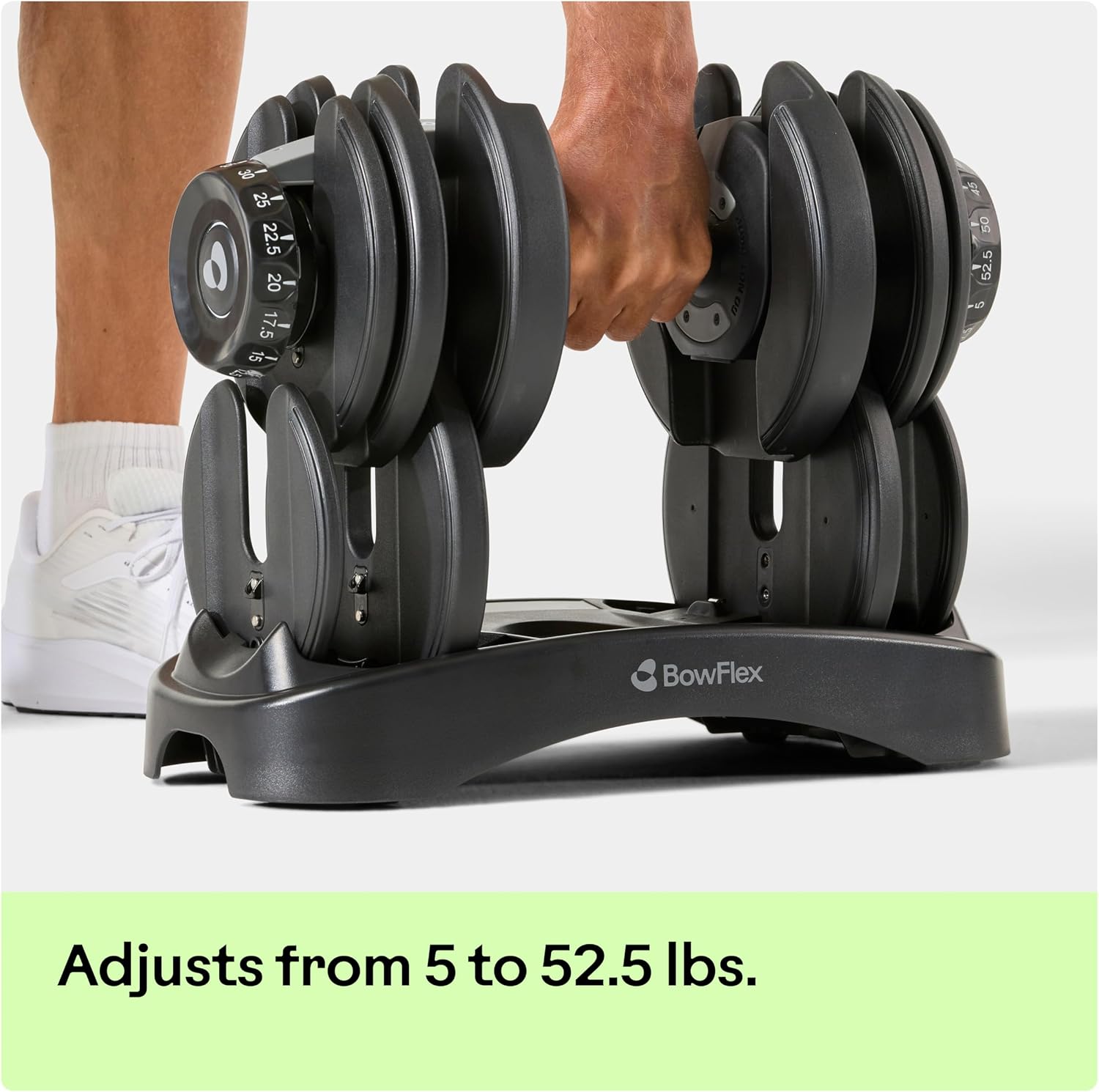
Adjustable dumbbells — a single set of weights that lets you change the load by turning a dial or sliding a selector pin, replacing an entire rack of fixed dumbbells — sound like the perfect solution for a shared home gym. One set, two users, problem solved. Except it’s rarely that tidy. When one partner tops out at 20 pounds and the other regularly trains with 50, the wrong dumbbell set quietly fails both of you: not heavy enough for the stronger lifter, not light enough to be safe or useful for the newer one. This guide works through that exact tension. You’ll come out with a clear decision framework — not vague brand praise, but honest tradeoffs — so you can commit to the right setup for your specific situation before you spend a dollar.
Why “Sharing” Is Harder Than It Looks
The conventional wisdom is straightforward: buy one adjustable set with a wide enough range and both partners are covered. In practice, three friction points show up consistently across owner reviews.
Range mismatch. Adjustable dumbbells typically run from 5 lbs to somewhere between 25 and 90 lbs per hand, depending on the model. If Partner A needs the 5 lb end for shoulder rehab work and Partner B needs 70 lbs for Romanian deadlifts, only a handful of sets on the market span that full range in a single unit. Barbend’s 2025 adjustable dumbbell buying guide notes that most mid-market sets optimize for a specific strength band — typically 5–52.5 lbs — and buyers who treat that upper limit as a ceiling rather than a ceiling-plus-buffer tend to regret it within 12–18 months.
Change-speed friction. In a solo session, slow weight changes are mildly annoying. When two people train back-to-back or circuit-style together, a 15-second dial adjustment becomes a real interruption. The mechanism type matters here: selectorized pin sets (like PowerBlock) tend to change faster than precision dial systems (like Bowflex’s incremental selector) because the weight stack is simply lifted out rather than mechanically engaged at each increment. Owner reviews across aggregated sources consistently flag this as a quality-of-life gap that only surfaces in shared use.
Accelerated wear. Two daily users put roughly twice the mechanical stress on any moving part — the dials, the locking mechanisms, the plastic selector cradles. Consumer Reports’ 2025 dumbbell ratings note that durability concerns cluster around high-cycle components: weight-selector mechanisms and the cradles that hold the weight plates in position during storage. One LifePro reviewer withheld a fifth star specifically because of plastic component uncertainty under extended use — a concern that scales up meaningfully when shared-use doubles the daily cycle count.
The Four Scenarios, and What Each One Actually Needs
Before comparing products, get clear on which scenario you’re actually in. Each one has a different optimal answer.
Scenario 1: Beginner + Beginner. Both partners are relatively new to strength training, neither exceeds 30–35 lbs per hand currently, and you expect to grow together. This is the easiest case. A mid-range set topping out at 52.5 lbs covers both of you for 2–3 years of consistent training. ACE Fitness research on progressive overload for beginners suggests that untrained individuals can expect meaningful strength gains for 18–24 months before plateau, so the 52.5 lb ceiling won’t feel cramped quickly. One quality set makes more sense here than two budget sets.
Scenario 2: Beginner + Intermediate. One partner is new; the other regularly trains at 40–65 lbs. This is the most common couple scenario and the one that gets people into trouble. A set that tops at 52.5 lbs works for the beginner but starts constraining the intermediate lifter within months. The Bowflex 552 — which runs from 5 to 52.5 lbs in 2.5-lb increments at the low end — is frequently cited in this context. A real reviewer framed the purchase explicitly as a couples’ solution: “my husband and I are obviously in two different leagues when it comes to lifting,” citing the wide incremental range as the deciding factor over buying separate sets. That incremental precision matters at the low end for the beginner; the 52.5 lb ceiling matters at the top for the intermediate. If the intermediate lifter is close to that ceiling today, though, consider moving up.
Scenario 3: Intermediate + Advanced. Both partners train seriously; one uses 50–70 lbs regularly and the other works at 70–90 lbs or more. Budget math shifts here. Two quality mid-market sets often makes more sense than one premium set, because the weight ranges diverge enough that no single unit serves both users without compromise. The Rendpas adjustable dumbbell draws a revealing data point: a reviewer bought two sets — one for themselves, one for a partner — suggesting that at a lower price point per unit, doubling up is a deliberate strategy rather than an extravagance. The per-pair economics only work if the individual unit cost is modest.
Scenario 4: One Partner Has Long-Term Goals. The PowerBlock Elite 90 has a reviewer with 20-plus years of PowerBlock ownership who upgraded to the heavier version — that longevity narrative is worth taking seriously for a couple making a long-term home-gym investment. If one or both partners plan to train seriously for a decade, the calculus tilts toward one premium set with an expandable weight range rather than cheaper sets that cap out and require replacement.
By the Numbers
| Set | Starting Weight | Max Weight | Weight Steps | Best Scenario |
|---|---|---|---|---|
| Bowflex 552 | 5 lbs | 52.5 lbs | 2.5 lb (low end) | Beginner + Intermediate |
| PowerBlock Elite EXP | 5 lbs | 50–90 lbs (expandable) | 2.5–10 lb | Intermediate + Advanced |
| PowerBlock Elite 90 | 5 lbs | 90 lbs | 2.5–10 lb | Long-term serious users |
| Rendpas | 5 lbs | 25–55 lbs (varies) | 5 lb | Budget: buy two sets |
| AOTOB | 5 lbs | 52.5–71.5 lbs | 5 lb | Budget-focused, single user |
Specs per manufacturer listings and published spec comparisons as of May 2026. AOTOB reviewer math pegs cost at approximately $2.20 per pound, versus $3–5/lb for Bowflex and PowerBlock — a real gap, though the tradeoff is mechanism precision and brand durability history.
The Case for One High-End Set vs. Two Budget Sets
This is the question every couple eventually lands on, and it deserves explicit math rather than hand-waving.
One high-end set — say, a PowerBlock Elite EXP starting at 50 lbs, expandable to 90 — runs roughly $300–$450 for the base unit. You get precision weight increments, a well-documented mechanism, and a brand with a 20-year owner review trail (per the long-tenure reviewer cited above). The tradeoff: if both partners want to train simultaneously, you’re waiting. One set means one person lifts at a time.
Two budget sets — two Rendpas or AOTOB units — might run $180–$280 total, and both partners can train at the same time. The tradeoff is mechanism longevity. Budget dial-adjust systems often use more plastic in the selector mechanism; under daily dual-user stress, that’s where wear concentrates. The LifePro reviewer who flagged plastic durability uncertainty was specifically modeling extended use — two daily users makes that concern more acute, not less.
The decision rule: If simultaneous training matters — both partners work out at the same time, not back-to-back — two sets is the answer, and budget depends on what you can absorb per unit. If you train in shifts and budget is constrained, one high-quality set almost always wins on a 3-year cost basis. Wirecutter’s dumbbell analysis consistently returns to the point that mechanism durability, not raw weight capacity, is what separates sets that last from sets that crack at the selector after 18 months of daily use.
One more consideration from Garage Strength’s fixed-vs-adjustable analysis: couples who upgrade in phases (one partner gets serious first, the other follows 6–12 months later) often buy one mid-range adjustable set now and add a second unit or fixed plates later. That staged approach avoids over-spending on day one.
Frequently Asked Questions
Can two people with very different strength levels share one adjustable dumbbell set? Yes, with the right set. The key is finding a unit whose range spans both users’ working weights — with enough headroom above the stronger lifter’s current max to stay useful as they progress. A 5–90 lb set handles almost any pairing. A 5–25 lb set doesn’t.
Is it better to buy one high-end set or two budget sets for a couple? Depends almost entirely on whether you train simultaneously or in shifts. Simultaneous training makes two sets necessary regardless of budget. Back-to-back training favors one quality set for durability and mechanism precision.
How fast can you change the weight on dial-adjust dumbbells between users? Dial-selector systems typically require 5–20 seconds per weight change, depending on the increment gap. Pin-select systems like PowerBlock can run faster — some owners report under 5 seconds. In a circuit where you’re cycling between weights frequently, those seconds add up. Reviews aggregated across multiple platforms note this more in shared-use situations than solo training.
Do adjustable dumbbells wear out faster when used by two people daily? Published durability concerns almost always center on the selector mechanism. Two daily users roughly double the cycle count on those components. Premium mechanisms (metal-dominant construction) handle this better than budget units with plastic selectors. If you’re in a two-user household, treat mechanism material as a primary spec, not a secondary one.
What is the lightest starting weight on the most popular adjustable dumbbell sets? Most sets start at 5 lbs per hand. A few start at 10 lbs. If one partner needs lighter loads for rehabilitation, mobility work, or early-stage training, confirm the floor weight before purchasing — some compact designs don’t go below 10 lbs even when advertised as “beginner-friendly.”
Is a dumbbell stand necessary or just a convenience accessory? It’s mostly convenience, but in a shared gym, convenience becomes a real productivity factor. Stands keep both sets accessible and off the floor, which matters when two people are moving around the same space. They also reduce floor impact on cradles and selector mechanisms over time. For a two-set household, stands are worth including in your total budget estimate from the start.
The Decision Rule
If you train in shifts and one of you is a beginner while the other is intermediate, the Bowflex 552’s range and incremental precision make it the cleaner single-set solution. If both partners are intermediate-to-advanced and train simultaneously, buy two sets — PowerBlock Elite EXP units if the budget allows, a pair of budget-category sets if it doesn’t, knowing you’re trading mechanism longevity for per-unit cost. If one partner is early in their training and the other has been at it for years and doesn’t plan to stop, buy for the serious lifter’s ceiling — a set that goes to 90 lbs grows with both of you and doesn’t need replacing in three years. The shared-gym decision is ultimately a logistics question dressed up as a shopping question: figure out how you actually train together before you figure out what you buy.